Imagine a house on a busy urban street. From the outside, it appears almost fortress-like — solid walls, minimal windows, a facade that reveals nothing of the life within. There is no way to look in. Street noise does not penetrate. Privacy is absolute.
Yet the moment the front door opens, an entirely different world unfolds: a generous living space, sunlight streaming in from a glass ceiling, a verdant garden at the heart of the home, and a kitchen that flows seamlessly into the relaxation area. Warm. Calm. Alive.
This is what architects call the introvert home — a design philosophy that has been gaining significant momentum across Indonesia, particularly in major cities such as Jakarta, Surabaya, and Bandung, where privacy has increasingly become its own form of luxury. This article explores what the introvert home is, why it resonates so deeply with contemporary urban life, and how the right interior system can bring it to life.
1. What Is 'Introvert Architecture'?
The term 'introvert home' in architectural discourse does not refer to a house that is closed off from sunlight or fresh air. Quite the opposite. The concept describes a design that redirects openness inward — not toward the street, but toward a private courtyard, an interior garden, or a pool hidden behind solid external walls.
The facade facing the street is deliberately designed to be solid and minimal in openings, resembling a boundary wall. This is not purely an aesthetic choice — it is a conscious lifestyle decision. In an era where privacy has become increasingly scarce, a growing number of homeowners choose not to have the rhythms of their daily life visible from the street.
The architectural challenge then presents itself: if the facade is closed, how does the home receive adequate natural light and air circulation? This is where the intelligence of introvert architecture is most evident — and the answers are far more elegant than one might initially expect.
2. The Skylight: Light from Above That Transforms Everything
The first and most dramatic solution in the introvert home is the skylight — a ceiling-mounted window that allows natural light to enter from above. Unlike conventional windows that require openings facing the street, a skylight faces the sky — preserving privacy entirely.
The visual effect of a well-positioned skylight is genuinely transformative. Light entering from above creates dynamic patterns of shadow and illumination throughout the day — different at morning, midday, and afternoon. A single skylight positioned thoughtfully above the main living area, a primary corridor, or even the master bedroom can dramatically alter the atmosphere of a room, transforming what might feel cramped into something spacious and vibrant.
In multi-storey homes, a skylight can also function as a void — a vertical opening connecting the ground and upper floors visually. Beyond conducting light, a void creates an impression of height that makes the entire home feel more monumental than its actual dimensions.
3. The Pocket Garden: Nature Hidden at the Heart of the Home
The most iconic element of the introvert home is the pocket garden — a small garden planted within the house, enclosed by walls on all sides. Large windows or floor-to-ceiling sliding glass doors face directly onto this garden, ensuring that from within the home, one is always presented with a calming green view.
Psychologically, the presence of plants and natural elements within the home is well-documented in reducing stress and improving focus. This is not merely an aesthetic trend — it is design grounded in the neuroscience of the human-nature relationship, known in architectural practice as biophilic design.
The pocket garden also resolves the issue of air circulation. With windows facing an open garden at the centre of the home, natural breezes can flow freely from one side to another — creating an effective passive ventilation system that simultaneously reduces dependence on mechanical air conditioning.
4. Blurring Indoor-Outdoor: Dissolving the Boundary Between Spaces
The concept that completes the introvert home is blurring indoor-outdoor design — quite literally dissolving the boundary between interior and exterior space. This is achieved through several complementary design techniques.
Bringing exterior materials indoors is one such technique. Andesite stone, Yogyakarta limestone, or exposed brick — materials traditionally reserved for outdoor surfaces — are now applied to interior walls, creating seamless visual continuity between the garden and the living room. The eye finds no clear 'boundary' between what is inside and what is outside.
Floor-to-ceiling sliding glass doors are another technique. When fully open, they completely eliminate the physical division between the living room and the garden, instantly doubling the perceived size of the space.
In this context, the selection of furniture and interior systems becomes critically important. A kitchen set, TV cabinet, and wardrobe designed with finishes that harmonise with exterior materials reinforce the seamless, intentional quality throughout the home. Conversely, mismatched furniture will sever the visual illusion the architecture is designed to create.
5. Concealed Storage: The Tidiness That Preserves Visual Peace
One principle inseparable from the introvert home is the minimisation of visual clutter. When the entire design philosophy of the home is built upon openness and spatial connectivity, a single pile of untidy objects is capable of disrupting the entire harmony.
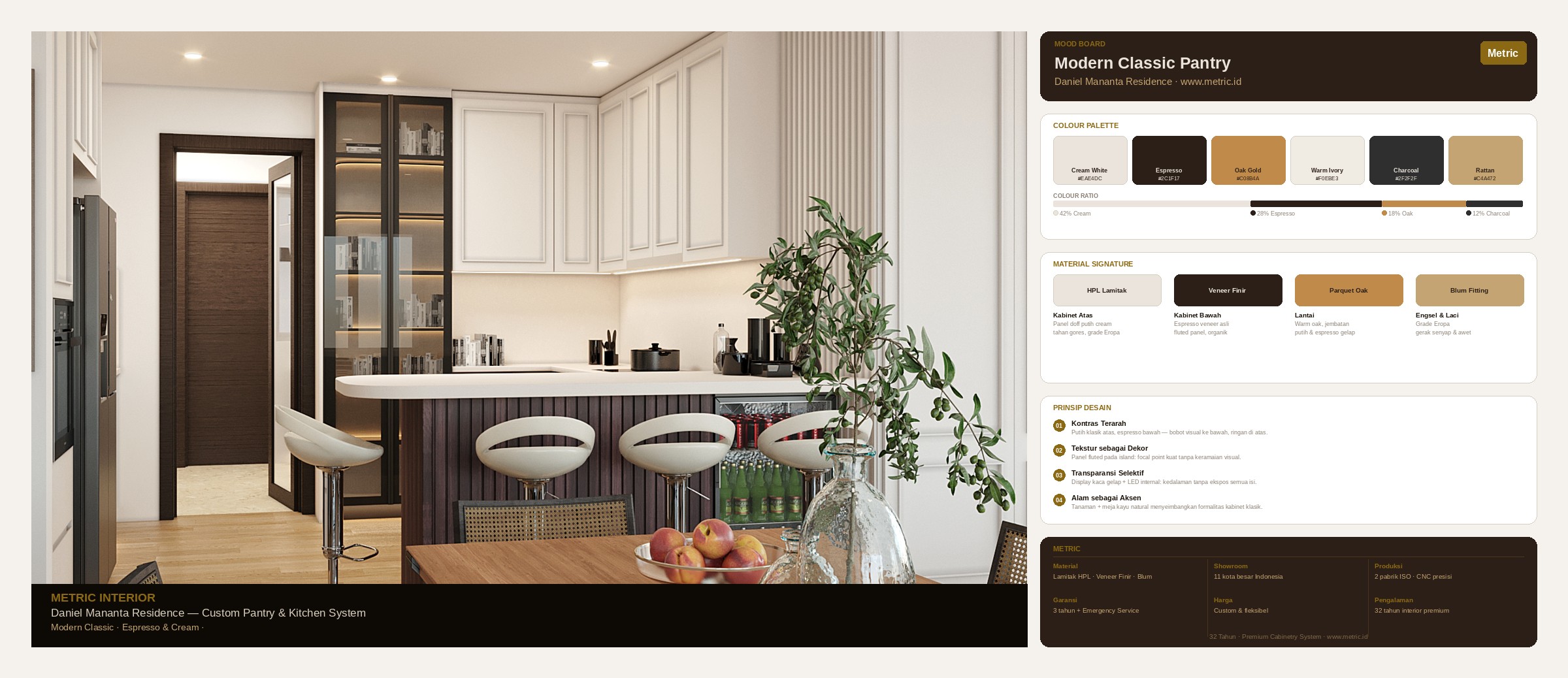
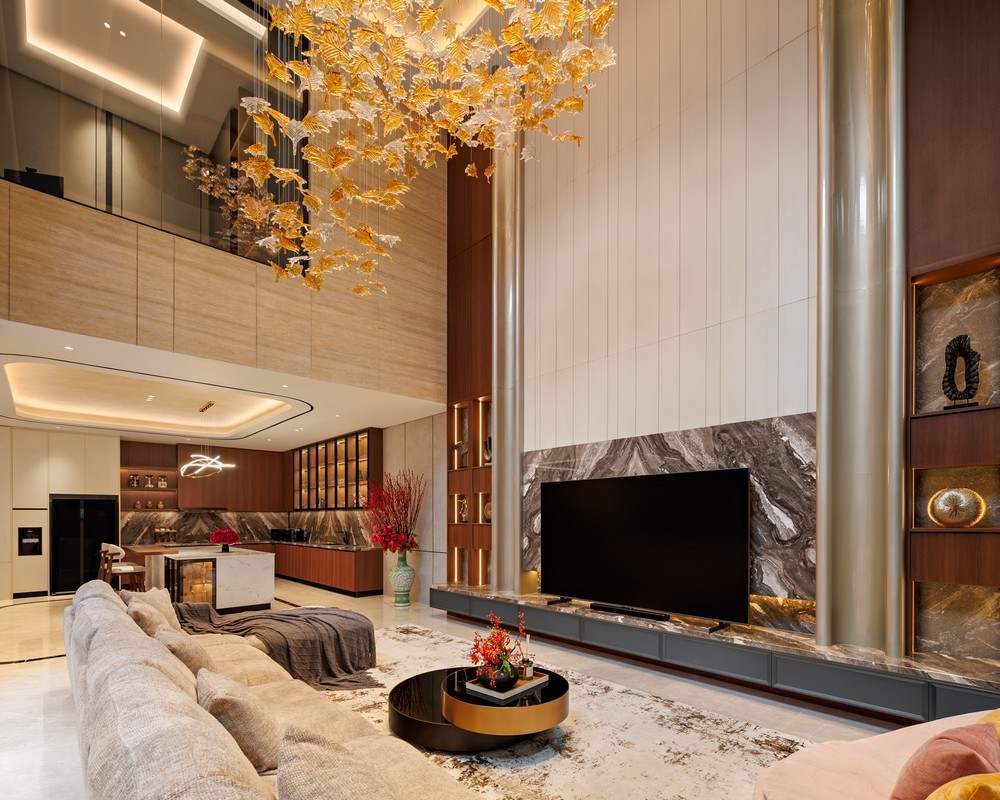
The solution is a thoughtfully planned system of concealed storage. A kitchen set whose panels merge seamlessly with the surrounding wall, a TV backdrop that integrates naturally with its marble surround, a floor-to-ceiling built-in wardrobe that eliminates every gap — all designed to conceal the realities of daily life behind clean, elegant surfaces.
This is precisely why a custom interior system is not merely an aesthetic preference in the introvert home — it is a structural necessity. Off-the-shelf furniture in standard dimensions can never fit perfectly into every corner and alcove, invariably leaving gaps, asymmetries, and a patchwork quality that undermines the architectural intent.
✦ METRIC: AFFORDABLE LUXURY
Many ask: why is Metric more expensive than other interior products? The answer is straightforward — because Metric does not simply sell cabinetry. Metric sells peace of mind.
Every Metric product is crafted using European-grade materials: Lamitak HPL laminates, Finir natural wood veneer, and Blum precision fittings — materials that not only look premium but are engineered to withstand years of intensive daily use without compromising quality.
Metric is premium because its production process employs internationally standardised CNC machinery across 2 ISO-certified factories — not manual fabrication prone to inconsistency. Every cut, every joint, every drawer is engineered to a standard of precision that mass-produced alternatives simply cannot achieve.
Yet what truly sets Metric apart is its philosophy: Affordable Luxury. Genuine luxury should not be the exclusive privilege of the few. Metric believes that every Indonesian family deserves beautiful, functional, and enduring interior design — through a planned investment and pricing that is flexible to each client's unique requirements.
A 3-year product warranty. Emergency service. 11 showrooms nationwide. That is not an added cost — that is the value you receive.
6. Colour and Material: A Palette That Unifies Every Element
A successfully executed introvert home always possesses a cohesive colour palette — typically drawn from warm neutrals such as cream, warm grey, off-white, and natural wood tones. These colours function as a neutral canvas that allows the natural elements — plants, water, and light — to take centre stage.
The most frequently used materials are a combination of natural stone, timber, glass, and steel. Each represents a different earthly element, yet they harmonise beautifully when combined with precision. The richness of their combined textures creates a visual depth that plain painted walls alone are entirely incapable of achieving.
For built-in cabinetry and furniture, wood veneer is the predominant choice for its ability to bring the warmth of natural timber with considerably lower maintenance requirements. The unique grain patterns on each veneer panel create natural variation that never appears repetitive or artificial.
7. The Introvert Home on a Constrained Plot: Solutions for Jakarta
A common concern is whether the introvert home concept can be applied to the limited plot sizes typical in Jakarta. The answer is unequivocally yes — with thoughtful planning.
The key to an introvert home on a narrow plot is vertical efficiency. Rather than requiring expansive horizontal footprint, the introvert home leverages height. Multi-level voids, stacked skylights, and high-level openings allow light and air to circulate freely even within a compact building footprint.
A documented case study from Jakarta demonstrates the concept on a 130 m² plot (6.5 x 20 m): a pocket garden integrated at the centre of the floor plan, a skylight positioned above the main corridor, and blurring indoor-outdoor design incorporated into the kitchen area. The key was a gradually rising floor elevation from front to rear, protecting the back of the house from flooding while maintaining visual connectivity throughout the home.
The introvert home is not a passing architectural trend. It is a considered and sophisticated response to the realities of dense, noisy, and privacy-depleted urban life. By inverting the orientation of the home — from facing outward to facing inward — it creates a genuinely private world in which its occupants can rest and recover completely.
Realising this vision, however, requires an interior system engineered with genuine precision. Every cabinet, every panel, every drawer must function as part of a harmonious whole — concealing the visual noise of daily life behind surfaces that are elegant, clean, and enduring.
"I have been using Metric for 10 years. Metric always prioritises service and quality, and the design is always up-to-date." — Mr. Sucipto, Medan
Consult with Metric's expert design team — for kitchen sets, TV cabinets, built-in wardrobes, and complete interior systems — at your nearest showroom, or explore a full portfolio of inspiration at www.metric.id. Backed by a 3-year product warranty, emergency service support, and 11 showrooms across Indonesia, the interior you have envisioned is well within reach.
© Metric | www.metric.id | @metric_id | 32 Years of Affordable Luxury Interior Design in Indonesia

Have you ever stepped into a five-star hotel room and paused — genuinely unable to move forward — struck by an intangible quality that felt difficult to define? It was not the square footage. It was not the price of the furniture. It was something far more deliberate and layered: the atmosphere. A sense of calm that appeared effortless, a tidiness that seemed natural, and a luxury that arose not from any single element but from the carefully considered harmony of the entire space.
The encouraging truth, long understood by professional interior designers, is that this atmosphere is not the exclusive product of an unlimited budget. It is the result of precise design decisions and — perhaps most critically — a well-designed storage system that was thoughtfully planned from the very beginning.
In this article, we reveal ten secrets that world-class designers use to create bedrooms that feel genuinely five-star — and how you can apply each of them to your own home, supported by the right interior system.
1. Immaculate Bed Linen: The First Foundation of Luxury
The first and most immediate signal of luxury in a hotel room is the condition of the bed. Smooth, wrinkle-free linen that is impeccably arranged communicates sophistication to anyone who enters. The good news is that achieving this does not require professional-grade equipment.
A simple technique used by professionals: lightly mist clean water over your fitted sheets once they are on the bed, then smooth them firmly with the palms of your hands. Creases disappear within minutes as the fabric dries naturally. Pair this with an investment in cotton sheets with a thread count of at least 400 — the difference in texture and coolness against the skin is immediately perceptible.
For the most cohesive visual result, choose neutral warm tones: ivory white, soft cream, or pale grey. These shades communicate cleanliness and spaciousness while remaining easy to coordinate with other decorative elements throughout the room.
2. Layered Curtains: Blackout and Sheer in Perfect Combination
Among the most visually impactful yet frequently overlooked elements of bedroom design is the window treatment. Five-star hotels are never equipped with a single layer of curtains — they invariably employ a layered system that masterfully balances function and aesthetics.
The first layer is the blackout curtain: a heavy, light-blocking panel that ensures complete darkness during sleep hours, uninterrupted by morning light or street illumination at night. The second layer is the sheer panel: a translucent, lightweight fabric that filters natural daylight into a soft, diffused glow during the day without sacrificing privacy.
Equally important is the method of installation. Mount your curtain rod directly beneath the ceiling — not above the window frame — and allow the curtains to fall in a continuous line to the floor. This technique psychologically expands the visible vertical wall space, creating the illusion of a higher ceiling and a more dramatic, intentional room. The transformation is striking, and it requires no structural renovation whatsoever.
3. One Large Statement Piece Rather Than Many Small Decorations
There is a design principle frequently violated by homeowners: the more decorative items displayed on a wall, the more cluttered the impression — and clutter is antithetical to luxury. Five-star hotels understand this instinctively.
Rather than filling your wall with a collection of family photographs or small decorative objects, select one large-format artwork — a statement piece — and position it prominently above the headboard. This single work becomes the room's focal point, immediately drawing the eye of anyone who enters.
The ideal proportion is approximately two-thirds of the headboard's width. For a 180 cm bed, an artwork measuring 110 to 120 cm in width creates the most balanced visual relationship. A high-quality print in an appropriately chosen frame is entirely capable of conveying the same sophisticated impression as an original artwork.
4. A Custom-Designed Storage System: The True Foundation of Tidiness
Here is the secret most frequently overlooked, yet most fundamentally important: no decoration, regardless of its quality or cost, can compensate for a disordered bedroom. And disorder almost always originates from inadequate or poorly designed storage.
Five-star hotels do not merely possess attractive rooms — they possess systems. Systems that ensure every item belonging to a guest has a designated, accessible place: from clothing stored in precision-fitted wardrobes, to small personal items concealed in purpose-built drawers.
This is precisely where a custom-designed bedroom set and wardrobe become indispensable. Mass-produced furniture is available in standard dimensions, but your home has its own unique measurements, requirements, and character. A wardrobe built to order — floor to ceiling, maximising every available centimetre of wall space — not only accommodates more, but creates a far cleaner and more intentional visual impression.
With more than 32 years of experience in Indonesia's premium interior industry, Metric has designed thousands of bedroom storage systems that are simultaneously highly functional and aesthetically refined. Utilising European-grade materials including natural wood veneer laminates such as Finir and precision fittings and hinges such as Blum, every detail is engineered to deliver a genuinely premium experience in daily use.
"Metric always prioritises service and quality, and the design is always up-to-date." — Mr. Sucipto, Metric client for 10 years, Medan
5. Bedside Tables with Concealed Storage: Clean Surfaces, Calm Mind
The bedside table occupies one of the most strategic positions in a bedroom — it remains within the line of sight whenever you are lying in bed. In a five-star hotel, the bedside surface is almost invariably uncluttered: a reading lamp, perhaps a single book, and occasionally a small plant.
The key to achieving this is not to possess fewer belongings, but to conceal them intelligently. A bedside table with concealed drawer storage allows you to keep phone chargers, medications, notebooks, and various small items entirely out of sight without making them inaccessible. The result is immediate visual calm upon entering the room.
Select a bedside table with at least one deep drawer and one open compartment. The open section accommodates items that require quick access; the drawer conceals everything that does not need to be visible at all times.
6. Layered Lighting: Three Layers of Light for a Perfect Atmosphere
The most common lighting error in bedroom design is reliance on a single overhead light source — typically a ceiling fixture positioned at the centre of the room. Single-source lighting creates harsh shadows and a flat, uninviting atmosphere that is far removed from the warm, intimate quality of a fine hotel room.
Five-star hotels consistently employ a three-layer lighting system:
The combination of all three layers enables you to adjust the room's atmosphere to suit any situation — bright and energising in the morning, warm and inviting in the evening, or softly dimmed and soothing at bedtime.
7. Patterned Glass on Wardrobe Doors: Refined Elegance Beyond Plain Mirrors
Plain mirrors on wardrobe doors serve a practical purpose, but their flat, highly reflective surface often imparts a cold and clinical quality that is at odds with the warm, luxurious atmosphere a bedroom should convey.
A technique increasingly favoured by premium interior designers is the replacement of plain mirrors with patterned glass or textured glass panels. These materials possess a softer reflective quality, introducing a far more refined and artistic visual character without sacrificing the panel's primary function.
Metric offers a comprehensive range of premium wardrobe finishing options using European-grade materials, including patterned glass selections that can be tailored to complement the colour scheme and aesthetic of your bedroom. Each panel is designed to ensure perfect visual consistency across the entire wardrobe.
8. An Aesthetically Considered Laundry Basket: Small Detail, Significant Impact
There is one element present in virtually every bedroom that rarely receives thoughtful design consideration: the laundry basket. Yet it occupies a corner of the room and remains visible every single day.
Replace a conventional plastic laundry basket with one crafted from natural woven rattan or linen canvas that carries genuine decorative value. Select proportions that suit the corner it will occupy — neither so small that it fills immediately, nor so large that it dominates the space. Neutral tones — cream, warm brown, or white — integrate naturally with virtually any interior theme.
This change may appear minor, but its cumulative effect on the overall impression of the room is disproportionately significant. Five-star hotels attend to every detail — and so can you.
9. Intentional Minimalism: Every Element Has a Purpose
Luxury is not synonymous with an empty room devoid of personality. Luxury is the quality of every present element having a clearly defined purpose, and being positioned with precision and intention.
This principle is known in interior design as intentional minimalism: a deliberate, considered simplicity that is the product of thoughtful curation, not indifference. You choose to display only those things that genuinely add value — whether aesthetic, functional, or emotional — and conceal everything else within an intelligent storage system.
Before adding any element to your bedroom, ask a simple question: does this make the room more beautiful, more functional, or more comfortable? If the answer is no — remove it. Deliberate simplicity is the highest form of luxury.
10. A Consistent Fragrance: Luxury for Every Sense
Genuine luxury is not only visible — it is felt, heard, and scented. Five-star hotels understand that a truly immersive experience engages all the senses, and fragrance is among the most powerful in creating lasting memory and emotional association.
Introduce a quality aromatherapy diffuser with a consistent, signature scent to your bedroom. Choose calming, neutral fragrances: lavender for relaxation, eucalyptus for freshness, or white tea for a clean, premium quality. Avoid anything too intense or sweet — fine hotels invariably select subtle, memorable scents that suggest refinement rather than demand attention.
Consistency is what makes this technique transformative. When the same fragrance is present every time you enter the room, the brain begins to associate it with rest, comfort, and sanctuary — a conditioned response that makes your bedroom feel like a genuinely personal retreat every single time you enter it.
Across all ten of the secrets outlined above, a single connecting principle emerges: the luxury of a bedroom is not determined by how much you purchase, but by how well every element is designed and placed.
And the foundation that allows every tip above to function at its highest potential is a well-designed storage system. A wardrobe built to precise measurements, a bedroom set that is genuinely functional, drawers that are easy to access yet conceal disorder with elegance. Without this foundation, even the finest decoration cannot produce the sense of luxury you are seeking to create.
As Liza, a Metric client from Central Jakarta, expressed: "The results of their work were as expected. I would rate them 9.5/10. You get what you pay for." True luxury is an investment that proves itself worthwhile — every morning, every evening, every time you step into your bedroom.
With more than 32 years of experience in Indonesia's premium interior industry, Metric is ready to help you design a custom bedroom set and wardrobe that is not only beautiful, but also highly functional and built to last. Using European-grade materials with a 3-year product warranty and emergency service support, every interior investment you make with Metric is comprehensively protected.
Our process is straightforward and structured: a design consultation period of approximately 2 weeks, followed by production and installation within 1 to 2 months depending on the number of rooms ordered. All pricing is custom and flexible, tailored to your chosen materials and specific requirements.
Visit your nearest Metric showroom — available in South Jakarta, North Jakarta, PIK2, BSD, Bandung, Medan, Surabaya, Yogyakarta, Bali, and Balikpapan — or explore our full portfolio of inspiration at www.metric.id.
Wardrobe choice matters when building or renovating a bedroom. Wardrobes help keep your clothing and belongings organized and readily available.
However, with so many options available in the market, choosing the right wardrobe for your bedroom can be a confusing task.
Here are some tips on choosing the right wardrobe for your bedroom:
1. Size:
Make sure that the size of the wardrobe you choose matches the size of your bedroom and has enough space to store your clothes and personal belongings.
2. Quality of material:
Choose a wardrobe that is made from high-quality materials that are durable and have enough strength to withstand the weight of your belongings.
3. Design:
Choose a design that matches the style and theme of your bedroom. This will help the wardrobe become an integral part of your room design and make it look like a part of the room, not just an addition.
4. Additional features:
Choose a wardrobe that has additional features such as clothes racks, shoe racks, or lighting systems that will help you store your belongings better.
5. Price:
Determine your budget and choose a wardrobe that has good quality and a reasonable price.
By considering the above points, you will be able to choose the right wardrobe for your bedroom and ensure that you have sufficient and efficient storage space. Don't rush into choosing a wardrobe and make sure to do your research and compare several options before making a final decision.
Building a Quality Space with a Premium Wardrobe: Tips for Looking Luxury"
Wardrobe is one of the most important parts of your home interior design. It plays a key role in making the room look neat and organized, as well as providing ample storage space for your clothes and personal belongings. However, with many wardrobe options available in the market, choosing the right one for your space can be a confusing task.
For millennials, looking luxurious and quality is very important. Therefore, having a stylish, elegant and premium wardrobe is something that should be prioritized. Here are some millennial tips for building a quality space with a premium wardrobe.
1.Choose quality materials
Wardrobe materials play an important role in influencing the look and quality of the product. Choose quality materials, such as solid wood or materials that are durable and have a smooth texture. This will give a luxurious look and give you a sense of security that the wardrobe will last a long time.
2.Elegant design
Elegant and minimalist design is one of the most popular trends nowadays. Choose a design that matches the interior style of your home and that has simple smooth lines. This will give it a luxurious and elegant look.
3.Choose the right color
Color can affect the mood and look of a room. Choose the right color for your wardrobe such as dark colors like black or dark brown to give a luxurious and elegant look.
4.Use illumination
The use of illumination on the wardrobe can give a more luxurious and elegant look. Choose a lamp with an attractive design and one that matches the interior style of your home.
5.Choose the right size
Choose a wardrobe size that suits your room and has enough storage space for your belongings. This will ensure that the wardrobe has a neat and organized look.
Adding a premium wardrobe to your home interior design is an effective way to make the room look more luxurious and quality. By considering the above factors, you can realize a premium wardrobe easily with Metric.
Imagine a house on a busy urban street. From the outside, it appears almost fortress-like — solid walls, minimal windows, a facade that reveals nothing of the life within. There is no way to look in. Street noise does not penetrate. Privacy is absolute.
Yet the moment the front door opens, an entirely different world unfolds: a generous living space, sunlight streaming in from a glass ceiling, a verdant garden at the heart of the home, and a kitchen that flows seamlessly into the relaxation area. Warm. Calm. Alive.
This is what architects call the introvert home — a design philosophy that has been gaining significant momentum across Indonesia, particularly in major cities such as Jakarta, Surabaya, and Bandung, where privacy has increasingly become its own form of luxury. This article explores what the introvert home is, why it resonates so deeply with contemporary urban life, and how the right interior system can bring it to life.
1. What Is 'Introvert Architecture'?
The term 'introvert home' in architectural discourse does not refer to a house that is closed off from sunlight or fresh air. Quite the opposite. The concept describes a design that redirects openness inward — not toward the street, but toward a private courtyard, an interior garden, or a pool hidden behind solid external walls.
The facade facing the street is deliberately designed to be solid and minimal in openings, resembling a boundary wall. This is not purely an aesthetic choice — it is a conscious lifestyle decision. In an era where privacy has become increasingly scarce, a growing number of homeowners choose not to have the rhythms of their daily life visible from the street.
The architectural challenge then presents itself: if the facade is closed, how does the home receive adequate natural light and air circulation? This is where the intelligence of introvert architecture is most evident — and the answers are far more elegant than one might initially expect.
2. The Skylight: Light from Above That Transforms Everything
The first and most dramatic solution in the introvert home is the skylight — a ceiling-mounted window that allows natural light to enter from above. Unlike conventional windows that require openings facing the street, a skylight faces the sky — preserving privacy entirely.
The visual effect of a well-positioned skylight is genuinely transformative. Light entering from above creates dynamic patterns of shadow and illumination throughout the day — different at morning, midday, and afternoon. A single skylight positioned thoughtfully above the main living area, a primary corridor, or even the master bedroom can dramatically alter the atmosphere of a room, transforming what might feel cramped into something spacious and vibrant.
In multi-storey homes, a skylight can also function as a void — a vertical opening connecting the ground and upper floors visually. Beyond conducting light, a void creates an impression of height that makes the entire home feel more monumental than its actual dimensions.
3. The Pocket Garden: Nature Hidden at the Heart of the Home
The most iconic element of the introvert home is the pocket garden — a small garden planted within the house, enclosed by walls on all sides. Large windows or floor-to-ceiling sliding glass doors face directly onto this garden, ensuring that from within the home, one is always presented with a calming green view.
Psychologically, the presence of plants and natural elements within the home is well-documented in reducing stress and improving focus. This is not merely an aesthetic trend — it is design grounded in the neuroscience of the human-nature relationship, known in architectural practice as biophilic design.
The pocket garden also resolves the issue of air circulation. With windows facing an open garden at the centre of the home, natural breezes can flow freely from one side to another — creating an effective passive ventilation system that simultaneously reduces dependence on mechanical air conditioning.
4. Blurring Indoor-Outdoor: Dissolving the Boundary Between Spaces
The concept that completes the introvert home is blurring indoor-outdoor design — quite literally dissolving the boundary between interior and exterior space. This is achieved through several complementary design techniques.
Bringing exterior materials indoors is one such technique. Andesite stone, Yogyakarta limestone, or exposed brick — materials traditionally reserved for outdoor surfaces — are now applied to interior walls, creating seamless visual continuity between the garden and the living room. The eye finds no clear 'boundary' between what is inside and what is outside.
Floor-to-ceiling sliding glass doors are another technique. When fully open, they completely eliminate the physical division between the living room and the garden, instantly doubling the perceived size of the space.
In this context, the selection of furniture and interior systems becomes critically important. A kitchen set, TV cabinet, and wardrobe designed with finishes that harmonise with exterior materials reinforce the seamless, intentional quality throughout the home. Conversely, mismatched furniture will sever the visual illusion the architecture is designed to create.
5. Concealed Storage: The Tidiness That Preserves Visual Peace
One principle inseparable from the introvert home is the minimisation of visual clutter. When the entire design philosophy of the home is built upon openness and spatial connectivity, a single pile of untidy objects is capable of disrupting the entire harmony.
The solution is a thoughtfully planned system of concealed storage. A kitchen set whose panels merge seamlessly with the surrounding wall, a TV backdrop that integrates naturally with its marble surround, a floor-to-ceiling built-in wardrobe that eliminates every gap — all designed to conceal the realities of daily life behind clean, elegant surfaces.
This is precisely why a custom interior system is not merely an aesthetic preference in the introvert home — it is a structural necessity. Off-the-shelf furniture in standard dimensions can never fit perfectly into every corner and alcove, invariably leaving gaps, asymmetries, and a patchwork quality that undermines the architectural intent.
✦ METRIC: AFFORDABLE LUXURY
Many ask: why is Metric more expensive than other interior products? The answer is straightforward — because Metric does not simply sell cabinetry. Metric sells peace of mind.
Every Metric product is crafted using European-grade materials: Lamitak HPL laminates, Finir natural wood veneer, and Blum precision fittings — materials that not only look premium but are engineered to withstand years of intensive daily use without compromising quality.
Metric is premium because its production process employs internationally standardised CNC machinery across 2 ISO-certified factories — not manual fabrication prone to inconsistency. Every cut, every joint, every drawer is engineered to a standard of precision that mass-produced alternatives simply cannot achieve.
Yet what truly sets Metric apart is its philosophy: Affordable Luxury. Genuine luxury should not be the exclusive privilege of the few. Metric believes that every Indonesian family deserves beautiful, functional, and enduring interior design — through a planned investment and pricing that is flexible to each client's unique requirements.
A 3-year product warranty. Emergency service. 11 showrooms nationwide. That is not an added cost — that is the value you receive.
6. Colour and Material: A Palette That Unifies Every Element
A successfully executed introvert home always possesses a cohesive colour palette — typically drawn from warm neutrals such as cream, warm grey, off-white, and natural wood tones. These colours function as a neutral canvas that allows the natural elements — plants, water, and light — to take centre stage.
The most frequently used materials are a combination of natural stone, timber, glass, and steel. Each represents a different earthly element, yet they harmonise beautifully when combined with precision. The richness of their combined textures creates a visual depth that plain painted walls alone are entirely incapable of achieving.
For built-in cabinetry and furniture, wood veneer is the predominant choice for its ability to bring the warmth of natural timber with considerably lower maintenance requirements. The unique grain patterns on each veneer panel create natural variation that never appears repetitive or artificial.
7. The Introvert Home on a Constrained Plot: Solutions for Jakarta
A common concern is whether the introvert home concept can be applied to the limited plot sizes typical in Jakarta. The answer is unequivocally yes — with thoughtful planning.
The key to an introvert home on a narrow plot is vertical efficiency. Rather than requiring expansive horizontal footprint, the introvert home leverages height. Multi-level voids, stacked skylights, and high-level openings allow light and air to circulate freely even within a compact building footprint.
A documented case study from Jakarta demonstrates the concept on a 130 m² plot (6.5 x 20 m): a pocket garden integrated at the centre of the floor plan, a skylight positioned above the main corridor, and blurring indoor-outdoor design incorporated into the kitchen area. The key was a gradually rising floor elevation from front to rear, protecting the back of the house from flooding while maintaining visual connectivity throughout the home.
The introvert home is not a passing architectural trend. It is a considered and sophisticated response to the realities of dense, noisy, and privacy-depleted urban life. By inverting the orientation of the home — from facing outward to facing inward — it creates a genuinely private world in which its occupants can rest and recover completely.
Realising this vision, however, requires an interior system engineered with genuine precision. Every cabinet, every panel, every drawer must function as part of a harmonious whole — concealing the visual noise of daily life behind surfaces that are elegant, clean, and enduring.
"I have been using Metric for 10 years. Metric always prioritises service and quality, and the design is always up-to-date." — Mr. Sucipto, Medan
Consult with Metric's expert design team — for kitchen sets, TV cabinets, built-in wardrobes, and complete interior systems — at your nearest showroom, or explore a full portfolio of inspiration at www.metric.id. Backed by a 3-year product warranty, emergency service support, and 11 showrooms across Indonesia, the interior you have envisioned is well within reach.
© Metric | www.metric.id | @metric_id | 32 Years of Affordable Luxury Interior Design in Indonesia

Have you ever stepped into a five-star hotel room and paused — genuinely unable to move forward — struck by an intangible quality that felt difficult to define? It was not the square footage. It was not the price of the furniture. It was something far more deliberate and layered: the atmosphere. A sense of calm that appeared effortless, a tidiness that seemed natural, and a luxury that arose not from any single element but from the carefully considered harmony of the entire space.
The encouraging truth, long understood by professional interior designers, is that this atmosphere is not the exclusive product of an unlimited budget. It is the result of precise design decisions and — perhaps most critically — a well-designed storage system that was thoughtfully planned from the very beginning.
In this article, we reveal ten secrets that world-class designers use to create bedrooms that feel genuinely five-star — and how you can apply each of them to your own home, supported by the right interior system.
1. Immaculate Bed Linen: The First Foundation of Luxury
The first and most immediate signal of luxury in a hotel room is the condition of the bed. Smooth, wrinkle-free linen that is impeccably arranged communicates sophistication to anyone who enters. The good news is that achieving this does not require professional-grade equipment.
A simple technique used by professionals: lightly mist clean water over your fitted sheets once they are on the bed, then smooth them firmly with the palms of your hands. Creases disappear within minutes as the fabric dries naturally. Pair this with an investment in cotton sheets with a thread count of at least 400 — the difference in texture and coolness against the skin is immediately perceptible.
For the most cohesive visual result, choose neutral warm tones: ivory white, soft cream, or pale grey. These shades communicate cleanliness and spaciousness while remaining easy to coordinate with other decorative elements throughout the room.
2. Layered Curtains: Blackout and Sheer in Perfect Combination
Among the most visually impactful yet frequently overlooked elements of bedroom design is the window treatment. Five-star hotels are never equipped with a single layer of curtains — they invariably employ a layered system that masterfully balances function and aesthetics.
The first layer is the blackout curtain: a heavy, light-blocking panel that ensures complete darkness during sleep hours, uninterrupted by morning light or street illumination at night. The second layer is the sheer panel: a translucent, lightweight fabric that filters natural daylight into a soft, diffused glow during the day without sacrificing privacy.
Equally important is the method of installation. Mount your curtain rod directly beneath the ceiling — not above the window frame — and allow the curtains to fall in a continuous line to the floor. This technique psychologically expands the visible vertical wall space, creating the illusion of a higher ceiling and a more dramatic, intentional room. The transformation is striking, and it requires no structural renovation whatsoever.
3. One Large Statement Piece Rather Than Many Small Decorations
There is a design principle frequently violated by homeowners: the more decorative items displayed on a wall, the more cluttered the impression — and clutter is antithetical to luxury. Five-star hotels understand this instinctively.
Rather than filling your wall with a collection of family photographs or small decorative objects, select one large-format artwork — a statement piece — and position it prominently above the headboard. This single work becomes the room's focal point, immediately drawing the eye of anyone who enters.
The ideal proportion is approximately two-thirds of the headboard's width. For a 180 cm bed, an artwork measuring 110 to 120 cm in width creates the most balanced visual relationship. A high-quality print in an appropriately chosen frame is entirely capable of conveying the same sophisticated impression as an original artwork.
4. A Custom-Designed Storage System: The True Foundation of Tidiness
Here is the secret most frequently overlooked, yet most fundamentally important: no decoration, regardless of its quality or cost, can compensate for a disordered bedroom. And disorder almost always originates from inadequate or poorly designed storage.
Five-star hotels do not merely possess attractive rooms — they possess systems. Systems that ensure every item belonging to a guest has a designated, accessible place: from clothing stored in precision-fitted wardrobes, to small personal items concealed in purpose-built drawers.
This is precisely where a custom-designed bedroom set and wardrobe become indispensable. Mass-produced furniture is available in standard dimensions, but your home has its own unique measurements, requirements, and character. A wardrobe built to order — floor to ceiling, maximising every available centimetre of wall space — not only accommodates more, but creates a far cleaner and more intentional visual impression.
With more than 32 years of experience in Indonesia's premium interior industry, Metric has designed thousands of bedroom storage systems that are simultaneously highly functional and aesthetically refined. Utilising European-grade materials including natural wood veneer laminates such as Finir and precision fittings and hinges such as Blum, every detail is engineered to deliver a genuinely premium experience in daily use.
"Metric always prioritises service and quality, and the design is always up-to-date." — Mr. Sucipto, Metric client for 10 years, Medan
5. Bedside Tables with Concealed Storage: Clean Surfaces, Calm Mind
The bedside table occupies one of the most strategic positions in a bedroom — it remains within the line of sight whenever you are lying in bed. In a five-star hotel, the bedside surface is almost invariably uncluttered: a reading lamp, perhaps a single book, and occasionally a small plant.
The key to achieving this is not to possess fewer belongings, but to conceal them intelligently. A bedside table with concealed drawer storage allows you to keep phone chargers, medications, notebooks, and various small items entirely out of sight without making them inaccessible. The result is immediate visual calm upon entering the room.
Select a bedside table with at least one deep drawer and one open compartment. The open section accommodates items that require quick access; the drawer conceals everything that does not need to be visible at all times.
6. Layered Lighting: Three Layers of Light for a Perfect Atmosphere
The most common lighting error in bedroom design is reliance on a single overhead light source — typically a ceiling fixture positioned at the centre of the room. Single-source lighting creates harsh shadows and a flat, uninviting atmosphere that is far removed from the warm, intimate quality of a fine hotel room.
Five-star hotels consistently employ a three-layer lighting system:
The combination of all three layers enables you to adjust the room's atmosphere to suit any situation — bright and energising in the morning, warm and inviting in the evening, or softly dimmed and soothing at bedtime.
7. Patterned Glass on Wardrobe Doors: Refined Elegance Beyond Plain Mirrors
Plain mirrors on wardrobe doors serve a practical purpose, but their flat, highly reflective surface often imparts a cold and clinical quality that is at odds with the warm, luxurious atmosphere a bedroom should convey.
A technique increasingly favoured by premium interior designers is the replacement of plain mirrors with patterned glass or textured glass panels. These materials possess a softer reflective quality, introducing a far more refined and artistic visual character without sacrificing the panel's primary function.
Metric offers a comprehensive range of premium wardrobe finishing options using European-grade materials, including patterned glass selections that can be tailored to complement the colour scheme and aesthetic of your bedroom. Each panel is designed to ensure perfect visual consistency across the entire wardrobe.
8. An Aesthetically Considered Laundry Basket: Small Detail, Significant Impact
There is one element present in virtually every bedroom that rarely receives thoughtful design consideration: the laundry basket. Yet it occupies a corner of the room and remains visible every single day.
Replace a conventional plastic laundry basket with one crafted from natural woven rattan or linen canvas that carries genuine decorative value. Select proportions that suit the corner it will occupy — neither so small that it fills immediately, nor so large that it dominates the space. Neutral tones — cream, warm brown, or white — integrate naturally with virtually any interior theme.
This change may appear minor, but its cumulative effect on the overall impression of the room is disproportionately significant. Five-star hotels attend to every detail — and so can you.
9. Intentional Minimalism: Every Element Has a Purpose
Luxury is not synonymous with an empty room devoid of personality. Luxury is the quality of every present element having a clearly defined purpose, and being positioned with precision and intention.
This principle is known in interior design as intentional minimalism: a deliberate, considered simplicity that is the product of thoughtful curation, not indifference. You choose to display only those things that genuinely add value — whether aesthetic, functional, or emotional — and conceal everything else within an intelligent storage system.
Before adding any element to your bedroom, ask a simple question: does this make the room more beautiful, more functional, or more comfortable? If the answer is no — remove it. Deliberate simplicity is the highest form of luxury.
10. A Consistent Fragrance: Luxury for Every Sense
Genuine luxury is not only visible — it is felt, heard, and scented. Five-star hotels understand that a truly immersive experience engages all the senses, and fragrance is among the most powerful in creating lasting memory and emotional association.
Introduce a quality aromatherapy diffuser with a consistent, signature scent to your bedroom. Choose calming, neutral fragrances: lavender for relaxation, eucalyptus for freshness, or white tea for a clean, premium quality. Avoid anything too intense or sweet — fine hotels invariably select subtle, memorable scents that suggest refinement rather than demand attention.
Consistency is what makes this technique transformative. When the same fragrance is present every time you enter the room, the brain begins to associate it with rest, comfort, and sanctuary — a conditioned response that makes your bedroom feel like a genuinely personal retreat every single time you enter it.
Across all ten of the secrets outlined above, a single connecting principle emerges: the luxury of a bedroom is not determined by how much you purchase, but by how well every element is designed and placed.
And the foundation that allows every tip above to function at its highest potential is a well-designed storage system. A wardrobe built to precise measurements, a bedroom set that is genuinely functional, drawers that are easy to access yet conceal disorder with elegance. Without this foundation, even the finest decoration cannot produce the sense of luxury you are seeking to create.
As Liza, a Metric client from Central Jakarta, expressed: "The results of their work were as expected. I would rate them 9.5/10. You get what you pay for." True luxury is an investment that proves itself worthwhile — every morning, every evening, every time you step into your bedroom.
With more than 32 years of experience in Indonesia's premium interior industry, Metric is ready to help you design a custom bedroom set and wardrobe that is not only beautiful, but also highly functional and built to last. Using European-grade materials with a 3-year product warranty and emergency service support, every interior investment you make with Metric is comprehensively protected.
Our process is straightforward and structured: a design consultation period of approximately 2 weeks, followed by production and installation within 1 to 2 months depending on the number of rooms ordered. All pricing is custom and flexible, tailored to your chosen materials and specific requirements.
Visit your nearest Metric showroom — available in South Jakarta, North Jakarta, PIK2, BSD, Bandung, Medan, Surabaya, Yogyakarta, Bali, and Balikpapan — or explore our full portfolio of inspiration at www.metric.id.
Wardrobe choice matters when building or renovating a bedroom. Wardrobes help keep your clothing and belongings organized and readily available.
However, with so many options available in the market, choosing the right wardrobe for your bedroom can be a confusing task.
Here are some tips on choosing the right wardrobe for your bedroom:
1. Size:
Make sure that the size of the wardrobe you choose matches the size of your bedroom and has enough space to store your clothes and personal belongings.
2. Quality of material:
Choose a wardrobe that is made from high-quality materials that are durable and have enough strength to withstand the weight of your belongings.
3. Design:
Choose a design that matches the style and theme of your bedroom. This will help the wardrobe become an integral part of your room design and make it look like a part of the room, not just an addition.
4. Additional features:
Choose a wardrobe that has additional features such as clothes racks, shoe racks, or lighting systems that will help you store your belongings better.
5. Price:
Determine your budget and choose a wardrobe that has good quality and a reasonable price.
By considering the above points, you will be able to choose the right wardrobe for your bedroom and ensure that you have sufficient and efficient storage space. Don't rush into choosing a wardrobe and make sure to do your research and compare several options before making a final decision.
Building a Quality Space with a Premium Wardrobe: Tips for Looking Luxury"
Wardrobe is one of the most important parts of your home interior design. It plays a key role in making the room look neat and organized, as well as providing ample storage space for your clothes and personal belongings. However, with many wardrobe options available in the market, choosing the right one for your space can be a confusing task.
For millennials, looking luxurious and quality is very important. Therefore, having a stylish, elegant and premium wardrobe is something that should be prioritized. Here are some millennial tips for building a quality space with a premium wardrobe.
1.Choose quality materials
Wardrobe materials play an important role in influencing the look and quality of the product. Choose quality materials, such as solid wood or materials that are durable and have a smooth texture. This will give a luxurious look and give you a sense of security that the wardrobe will last a long time.
2.Elegant design
Elegant and minimalist design is one of the most popular trends nowadays. Choose a design that matches the interior style of your home and that has simple smooth lines. This will give it a luxurious and elegant look.
3.Choose the right color
Color can affect the mood and look of a room. Choose the right color for your wardrobe such as dark colors like black or dark brown to give a luxurious and elegant look.
4.Use illumination
The use of illumination on the wardrobe can give a more luxurious and elegant look. Choose a lamp with an attractive design and one that matches the interior style of your home.
5.Choose the right size
Choose a wardrobe size that suits your room and has enough storage space for your belongings. This will ensure that the wardrobe has a neat and organized look.
Adding a premium wardrobe to your home interior design is an effective way to make the room look more luxurious and quality. By considering the above factors, you can realize a premium wardrobe easily with Metric.