Metric
May 21, 2026

How to Easily Create Your Own Interior Design Mood Board Using Canva

A home renovation is one of the most significant decisions a family will make — both financially and emotionally. Yet there is one step that is consistently overlooked by nearly every first-time renovator: creating a mood board before speaking to anyone.

Without a mood board, conversations with an interior designer or contractor begin from a vague and undefined starting point. You know that you want something 'modern but warm', or 'minimalist but not sterile', or 'natural but not too rustic' — but those words alone can carry a hundred different interpretations in the mind of each person who hears them. The result? Miscommunication, repeated revisions, and often a budget that expands far beyond the original estimate.

A mood board changes all of this. It transforms feelings and aspirations that are still abstract into concrete visual references — something that can be pointed to, discussed, and agreed upon before a single material is purchased or a single task begins. And the good news is that creating a professional-quality mood board requires no special design skill. With Canva — a free design platform accessible from any browser or smartphone — anyone can produce an effective mood board in under an hour.

1. What Is a Mood Board and Why Does It Matter So Much?

A mood board is a collection of images, colours, textures, and visual references assembled into a single composition to represent the atmosphere or design style one wishes to create. In professional interior design practice, the mood board is the first working document produced — before technical drawings, before budgeting, and even before any detailed consultation.

The function of a mood board extends far beyond aesthetics. It serves as a 'map' that guides the entire renovation journey:

  • It helps you identify and clarify visual preferences that previously existed only as vague feelings.
  • It functions as a universal communication tool between you, your designer, and your contractor — eliminating linguistic ambiguity.
  • It allows you to detect early whether the individual elements you are drawn to are actually incompatible when combined.
  • It prevents impulse purchases of furniture or decorative items that appear attractive in isolation but do not harmonise with the overall concept.
  • It saves time and money in the long term by reducing revisions and material selection errors.

Professional interior designers worldwide use mood boards not out of tradition, but because they are proven to dramatically reduce miscommunication and produce outcomes that more closely reflect client expectations.

📎 Internal Link: https://metric.id/en/inspiration

2. Understanding Design Styles: Discovering Your Visual Identity

Before opening Canva, the crucial first step is understanding the design style you genuinely want. This sounds straightforward, yet many homeowners discover that they are drawn to several quite different styles — and selecting one as the foundation requires deeper reflection than initially expected.

Some of the most popular design styles currently in Indonesia:

  • **Japandi** — a fusion of Japanese and Scandinavian aesthetics. Emphasises simplicity, natural materials (light timber, bamboo, linen), and the philosophy of 'less is more'. Colour palette: white, soft grey, cream, and natural wood tones.
  • **Modern Tropical** — blending contemporary architecture with tropical natural elements. Features generous use of timber, natural stone, indoor plants, and large openings that invite light and air. Colour palette: deep green, wood brown, cream, and white.
  • **Mid-Century Modern** — inspired by design from the 1950s and 1960s. Characterised by furniture with slender tapered legs, an earthy colour palette (mustard, terracotta, olive), and the pairing of walnut timber with metal accents.
  • **Contemporary Minimalist** — clean spaces, neutral colours, and function as the primary consideration. This does not mean empty — rather, every element is chosen with considerable selectivity and serves a clear purpose.

If you are still uncertain of your direction, begin with Pinterest or Instagram — save every image of a room that causes you to pause your scroll for more than three seconds. After accumulating 20 to 30 images, a consistent visual pattern will almost invariably begin to emerge.

3. Step-by-Step Guide to Creating a Mood Board in Canva

The following is a practical guide to creating an effective interior design mood board using Canva:

  1. **Open Canva and select your canvas size.** Access canva.com or download the Canva app on your smartphone (free). Select 'Create a Design' and choose the presentation size (1920x1080 px) or A3 landscape format for more working space.
  2. **Divide your canvas into zones.** An effective mood board is typically organised into several distinct areas: a primary colour palette zone, a materials and textures zone (timber, stone, fabric), a furniture reference zone, and an overall atmosphere zone. Use simple guides or boxes to delineate these areas.
  3. **Collect your reference images.** Upload images from Pinterest, Instagram, or your favourite designer websites. You can also use Canva's built-in image search. Focus on images that represent: the overall room atmosphere you are seeking, specific materials you are drawn to, and colours that consistently attract your attention.
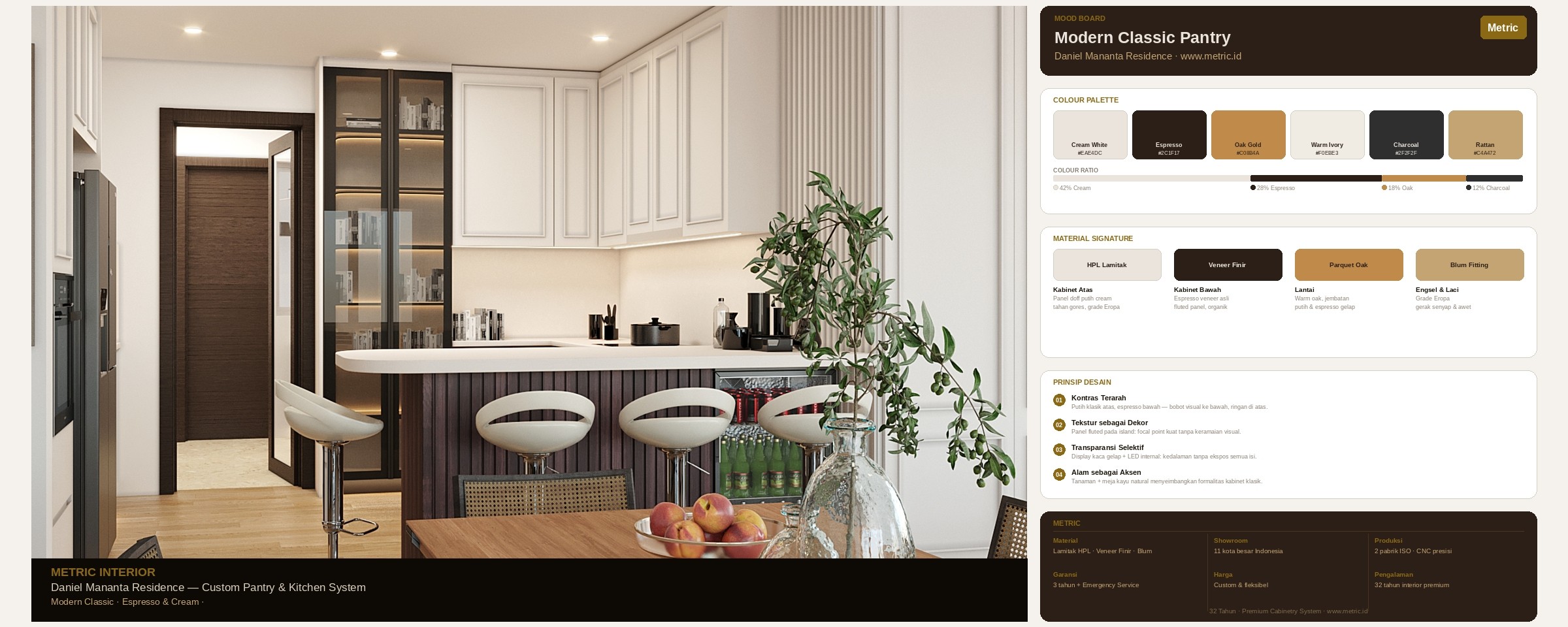
  4. **Build your colour palette.** This is the most critical element of the mood board. Select 3 to 5 primary colours that will dominate the space. Use Canva's 'Color Palette Generator' feature or extract colours directly from your reference photos using the eyedropper tool. Ensure that the selected colours harmonise with one another.
  5. **Add material swatches.** Include images or photographs of the materials you wish to use: timber species, cabinet finish colours, floor tile types, curtain fabric materials. This is an area where consultation with the Metric team is particularly valuable — viewing physical material samples is a fundamentally different experience from viewing them on screen.
  6. **Add notes and labels.** Include brief text annotations for each element to clarify its context: 'Primary wall colour', 'Flooring material', 'Kitchen set reference', 'Cabinet timber tone'. These notes are extremely useful when the mood board is discussed with a designer.
  7. **Review the whole critically.** Once all elements are in place, step back and ask: does everything feel cohesive? Is there one element that is 'shouting' too loudly among the others? Edit decisively — a focused mood board with 10 carefully selected elements is far more useful than one containing 40 disparate images.

🖼 Alt Text: Canva application interface showing an interior design mood board being created with warm neutral palette

📎 Internal Link:https://metric.id/en/inspiration

4. Four Essential Elements Every Interior Mood Board Must Include

An effective mood board for interior renovation purposes must contain at least four key elements:

1. Colour Palette — A minimum of 3 colours: a dominant colour (60% of the space), a supporting colour (30%), and an accent colour (10%). For example, in a Japandi style: warm cream as the dominant, light natural timber as the supporting tone, and black or dark grey as the accent.

2. Materials and Textures — Visual references for every primary surface: flooring, walls, ceiling, and cabinetry. For cabinetry specifically, establish whether you prefer a matte or gloss finish, and whether you are drawn to HPL, wood veneer, or duco paint. These material choices have a significant impact on both the budget and the final aesthetic.

3. Furniture and Built-In References — Images representing the style and proportion of the furniture you envision: cabinet heights, door profiles (flat panel, shaker, or with moulding details), colours and materials, and how the furniture relates to the surrounding walls. This is the most critical information for the Metric design team to begin planning.

4. Atmosphere and Mood — One or two room images that most closely capture the overall feeling you wish to achieve. Not about the details, but about the 'energy' of the space: is it calm and meditative, or warm and lively? Dramatic and bold, or soft and understated?

5. Common Mistakes to Avoid

Based on 32 years of experience accompanying clients of diverse backgrounds, Metric's design team has identified the most frequent errors made in mood board creation:

  • **Combining too many styles simultaneously.** Being drawn to Japandi, Industrial, and Tropical all at once can result in a space with no clear identity. Choose one primary style as the foundation and incorporate influences from other styles selectively as accents.
  • **Failing to account for lighting conditions.** Colours on a computer screen can appear very different from the same colours under a room's actual lighting. Once the mood board is complete, always discuss with your designer how the planned lighting will affect the appearance of the chosen materials.
  • **Ignoring proportion and scale.** Images in a mood board carry no scale — a sofa that appears perfect in a photograph may be overwhelming in your 3x4 metre living room. Always communicate room dimensions when discussing your mood board with a designer.
  • **Keeping the mood board to yourself.** A mood board that is not shared with your designer or contractor cannot perform its function as a communication tool. Bring your mood board to your first meeting and place it at the centre of the discussion.

6. From Mood Board to Reality: The Role of Professional Consultation

A beautiful mood board is the starting point — not the destination. The crucial next step is consultation with an interior designer or production team who can translate the mood board into technical plans that can be executed with genuine precision.

In the Metric consultation process, your mood board becomes the foundation for discussion across several important areas: the suitability of your desired materials to the room dimensions and available budget, recommendations for finishes and hardware that most closely realise your vision, a layout simulation that ensures every centimetre of the space is maximised, and a realistic production timeline.

Metric's design team is experienced in working from client mood boards — even those that are still very simple and rough. What matters is not the visual perfection of the mood board, but the clarity of vision it communicates. From that clarity, the collaboration begins.

✦  METRIC: AFFORDABLE LUXURY

Once your mood board is complete and your design vision is clearly defined, the next step is finding a production partner capable of realising it with genuine precision. This is where a frequently asked question arises: why is Metric more expensive than standard furniture retailers or general contractors?

Because Metric does not merely sell products — Metric realises visions. Every element in your mood board, from your chosen timber palette to the cabinet finishes you have envisioned, is executed using European-grade materials such as Lamitak HPL, Finir natural wood veneer, and Blum precision fittings — produced using ISO-certified CNC machinery across 2 modern factories.

Metric is premium not only because of its raw materials. It is the entire ecosystem: a design team that translates your mood board into precise technical drawings, a production process that is measured and controlled at every stage, installation by experienced specialists, and an after-sales service ready to respond whenever needed.

And all of this is delivered within the philosophy of Affordable Luxury: luxury that can be planned and budgeted wisely, not luxury that overextends. Pricing that is custom and flexible to the rooms and materials you select, protected by a 3-year product warranty. Your beautiful mood board deserves to be realised by the right hands.

Bring your mood board to a Metric showroom — our team is ready to translate every detail of your vision into reality.

Conclusion

A mood board is not a luxury reserved for professional designers — it is a tool that every homeowner planning a renovation should possess, regardless of the scale of the project. With Canva being free and straightforward to use, there is no good reason to begin a renovation without a clear visual map.

Invest one hour in creating a thoughtful mood board, and you will save months of revisions, countless impulsive decisions you would later regret, and significant budget that would otherwise be lost to miscommunication. That is a return on investment that no other single decision in the renovation process can rival.

"The results of their work were as expected. I would rate them 9.5/10. You get what you pay for. I trust Metric more because it was recommended by my family."  — Liza, Central Jakarta

Once your mood board is ready, bring it to your nearest Metric showroom and discuss it with our design team. From kitchen sets to custom wardrobes, from bedroom sets to TV cabinets — we are ready to translate every detail of your vision into an interior that is beautiful, functional, and built to last. Visit www.metric.id to schedule a consultation or explore our full design inspiration gallery.


© Metric | www.metric.id | @metric_id | 32 Years of Affordable Luxury Interior Design in Indonesia

Metric
May 21, 2026
How to Easily Create Your Own Interior Design Mood Board Using Canva

A home renovation is one of the most significant decisions a family will make — both financially and emotionally. Yet there is one step that is consistently overlooked by nearly every first-time renovator: creating a mood board before speaking to anyone.

Without a mood board, conversations with an interior designer or contractor begin from a vague and undefined starting point. You know that you want something 'modern but warm', or 'minimalist but not sterile', or 'natural but not too rustic' — but those words alone can carry a hundred different interpretations in the mind of each person who hears them. The result? Miscommunication, repeated revisions, and often a budget that expands far beyond the original estimate.

A mood board changes all of this. It transforms feelings and aspirations that are still abstract into concrete visual references — something that can be pointed to, discussed, and agreed upon before a single material is purchased or a single task begins. And the good news is that creating a professional-quality mood board requires no special design skill. With Canva — a free design platform accessible from any browser or smartphone — anyone can produce an effective mood board in under an hour.

1. What Is a Mood Board and Why Does It Matter So Much?

A mood board is a collection of images, colours, textures, and visual references assembled into a single composition to represent the atmosphere or design style one wishes to create. In professional interior design practice, the mood board is the first working document produced — before technical drawings, before budgeting, and even before any detailed consultation.

The function of a mood board extends far beyond aesthetics. It serves as a 'map' that guides the entire renovation journey:

  • It helps you identify and clarify visual preferences that previously existed only as vague feelings.
  • It functions as a universal communication tool between you, your designer, and your contractor — eliminating linguistic ambiguity.
  • It allows you to detect early whether the individual elements you are drawn to are actually incompatible when combined.
  • It prevents impulse purchases of furniture or decorative items that appear attractive in isolation but do not harmonise with the overall concept.
  • It saves time and money in the long term by reducing revisions and material selection errors.

Professional interior designers worldwide use mood boards not out of tradition, but because they are proven to dramatically reduce miscommunication and produce outcomes that more closely reflect client expectations.

📎 Internal Link: https://metric.id/en/inspiration

2. Understanding Design Styles: Discovering Your Visual Identity

Before opening Canva, the crucial first step is understanding the design style you genuinely want. This sounds straightforward, yet many homeowners discover that they are drawn to several quite different styles — and selecting one as the foundation requires deeper reflection than initially expected.

Some of the most popular design styles currently in Indonesia:

  • **Japandi** — a fusion of Japanese and Scandinavian aesthetics. Emphasises simplicity, natural materials (light timber, bamboo, linen), and the philosophy of 'less is more'. Colour palette: white, soft grey, cream, and natural wood tones.
  • **Modern Tropical** — blending contemporary architecture with tropical natural elements. Features generous use of timber, natural stone, indoor plants, and large openings that invite light and air. Colour palette: deep green, wood brown, cream, and white.
  • **Mid-Century Modern** — inspired by design from the 1950s and 1960s. Characterised by furniture with slender tapered legs, an earthy colour palette (mustard, terracotta, olive), and the pairing of walnut timber with metal accents.
  • **Contemporary Minimalist** — clean spaces, neutral colours, and function as the primary consideration. This does not mean empty — rather, every element is chosen with considerable selectivity and serves a clear purpose.

If you are still uncertain of your direction, begin with Pinterest or Instagram — save every image of a room that causes you to pause your scroll for more than three seconds. After accumulating 20 to 30 images, a consistent visual pattern will almost invariably begin to emerge.

3. Step-by-Step Guide to Creating a Mood Board in Canva

The following is a practical guide to creating an effective interior design mood board using Canva:

  1. **Open Canva and select your canvas size.** Access canva.com or download the Canva app on your smartphone (free). Select 'Create a Design' and choose the presentation size (1920x1080 px) or A3 landscape format for more working space.
  2. **Divide your canvas into zones.** An effective mood board is typically organised into several distinct areas: a primary colour palette zone, a materials and textures zone (timber, stone, fabric), a furniture reference zone, and an overall atmosphere zone. Use simple guides or boxes to delineate these areas.
  3. **Collect your reference images.** Upload images from Pinterest, Instagram, or your favourite designer websites. You can also use Canva's built-in image search. Focus on images that represent: the overall room atmosphere you are seeking, specific materials you are drawn to, and colours that consistently attract your attention.
  4. **Build your colour palette.** This is the most critical element of the mood board. Select 3 to 5 primary colours that will dominate the space. Use Canva's 'Color Palette Generator' feature or extract colours directly from your reference photos using the eyedropper tool. Ensure that the selected colours harmonise with one another.
  5. **Add material swatches.** Include images or photographs of the materials you wish to use: timber species, cabinet finish colours, floor tile types, curtain fabric materials. This is an area where consultation with the Metric team is particularly valuable — viewing physical material samples is a fundamentally different experience from viewing them on screen.
  6. **Add notes and labels.** Include brief text annotations for each element to clarify its context: 'Primary wall colour', 'Flooring material', 'Kitchen set reference', 'Cabinet timber tone'. These notes are extremely useful when the mood board is discussed with a designer.
  7. **Review the whole critically.** Once all elements are in place, step back and ask: does everything feel cohesive? Is there one element that is 'shouting' too loudly among the others? Edit decisively — a focused mood board with 10 carefully selected elements is far more useful than one containing 40 disparate images.

🖼 Alt Text: Canva application interface showing an interior design mood board being created with warm neutral palette

📎 Internal Link:https://metric.id/en/inspiration

4. Four Essential Elements Every Interior Mood Board Must Include

An effective mood board for interior renovation purposes must contain at least four key elements:

1. Colour Palette — A minimum of 3 colours: a dominant colour (60% of the space), a supporting colour (30%), and an accent colour (10%). For example, in a Japandi style: warm cream as the dominant, light natural timber as the supporting tone, and black or dark grey as the accent.

2. Materials and Textures — Visual references for every primary surface: flooring, walls, ceiling, and cabinetry. For cabinetry specifically, establish whether you prefer a matte or gloss finish, and whether you are drawn to HPL, wood veneer, or duco paint. These material choices have a significant impact on both the budget and the final aesthetic.

3. Furniture and Built-In References — Images representing the style and proportion of the furniture you envision: cabinet heights, door profiles (flat panel, shaker, or with moulding details), colours and materials, and how the furniture relates to the surrounding walls. This is the most critical information for the Metric design team to begin planning.

4. Atmosphere and Mood — One or two room images that most closely capture the overall feeling you wish to achieve. Not about the details, but about the 'energy' of the space: is it calm and meditative, or warm and lively? Dramatic and bold, or soft and understated?

5. Common Mistakes to Avoid

Based on 32 years of experience accompanying clients of diverse backgrounds, Metric's design team has identified the most frequent errors made in mood board creation:

  • **Combining too many styles simultaneously.** Being drawn to Japandi, Industrial, and Tropical all at once can result in a space with no clear identity. Choose one primary style as the foundation and incorporate influences from other styles selectively as accents.
  • **Failing to account for lighting conditions.** Colours on a computer screen can appear very different from the same colours under a room's actual lighting. Once the mood board is complete, always discuss with your designer how the planned lighting will affect the appearance of the chosen materials.
  • **Ignoring proportion and scale.** Images in a mood board carry no scale — a sofa that appears perfect in a photograph may be overwhelming in your 3x4 metre living room. Always communicate room dimensions when discussing your mood board with a designer.
  • **Keeping the mood board to yourself.** A mood board that is not shared with your designer or contractor cannot perform its function as a communication tool. Bring your mood board to your first meeting and place it at the centre of the discussion.

6. From Mood Board to Reality: The Role of Professional Consultation

A beautiful mood board is the starting point — not the destination. The crucial next step is consultation with an interior designer or production team who can translate the mood board into technical plans that can be executed with genuine precision.

In the Metric consultation process, your mood board becomes the foundation for discussion across several important areas: the suitability of your desired materials to the room dimensions and available budget, recommendations for finishes and hardware that most closely realise your vision, a layout simulation that ensures every centimetre of the space is maximised, and a realistic production timeline.

Metric's design team is experienced in working from client mood boards — even those that are still very simple and rough. What matters is not the visual perfection of the mood board, but the clarity of vision it communicates. From that clarity, the collaboration begins.

✦  METRIC: AFFORDABLE LUXURY

Once your mood board is complete and your design vision is clearly defined, the next step is finding a production partner capable of realising it with genuine precision. This is where a frequently asked question arises: why is Metric more expensive than standard furniture retailers or general contractors?

Because Metric does not merely sell products — Metric realises visions. Every element in your mood board, from your chosen timber palette to the cabinet finishes you have envisioned, is executed using European-grade materials such as Lamitak HPL, Finir natural wood veneer, and Blum precision fittings — produced using ISO-certified CNC machinery across 2 modern factories.

Metric is premium not only because of its raw materials. It is the entire ecosystem: a design team that translates your mood board into precise technical drawings, a production process that is measured and controlled at every stage, installation by experienced specialists, and an after-sales service ready to respond whenever needed.

And all of this is delivered within the philosophy of Affordable Luxury: luxury that can be planned and budgeted wisely, not luxury that overextends. Pricing that is custom and flexible to the rooms and materials you select, protected by a 3-year product warranty. Your beautiful mood board deserves to be realised by the right hands.

Bring your mood board to a Metric showroom — our team is ready to translate every detail of your vision into reality.

Conclusion

A mood board is not a luxury reserved for professional designers — it is a tool that every homeowner planning a renovation should possess, regardless of the scale of the project. With Canva being free and straightforward to use, there is no good reason to begin a renovation without a clear visual map.

Invest one hour in creating a thoughtful mood board, and you will save months of revisions, countless impulsive decisions you would later regret, and significant budget that would otherwise be lost to miscommunication. That is a return on investment that no other single decision in the renovation process can rival.

"The results of their work were as expected. I would rate them 9.5/10. You get what you pay for. I trust Metric more because it was recommended by my family."  — Liza, Central Jakarta

Once your mood board is ready, bring it to your nearest Metric showroom and discuss it with our design team. From kitchen sets to custom wardrobes, from bedroom sets to TV cabinets — we are ready to translate every detail of your vision into an interior that is beautiful, functional, and built to last. Visit www.metric.id to schedule a consultation or explore our full design inspiration gallery.


© Metric | www.metric.id | @metric_id | 32 Years of Affordable Luxury Interior Design in Indonesia

More News?
Back to Blog
Full Story: Read More