7 Design Tricks to Make a Small Room Feel Spacious and Open
There is a persistent myth among Indonesian homeowners that a spacious-feeling home is the exclusive privilege of those with large plots of land. In reality, the sense of spaciousness in a room has far less to do with its actual square footage than with how that space is designed and organised.
Professional interior designers have long understood that the perception of space is a science. The human brain processes its environment through visual signals — lines, surfaces, colours, and textures — and each of these signals can be deliberately and intelligently manipulated to create an impression of a room that differs significantly from its actual dimensions.
In this article, Metric shares 7 evidence-based design tricks used by professional designers to make small rooms feel genuinely spacious, open, and comfortable — without major structural renovation or the acquisition of additional land.
1. Choose Wide-Format Flooring with Minimal Grout Lines
The first secret lies beneath your feet. The type and size of your floor covering has a far greater impact on the perceived size of a room than most people realise.
The principle is straightforward: the fewer visual interruptions on the floor surface, the more spacious the room appears. Small tiles — such as 20x20 cm mosaic — create dozens or even hundreds of grout lines that continuously interrupt the eye's field of vision. The brain registers each of these lines as a 'boundary', and unconsciously interprets the room as smaller than its actual dimensions.
Conversely, wide-format flooring materials — large-cut marble at 80x80 cm or 120x120 cm, large-format granite, or long-plank SPC (*Stone Plastic Composite*) — minimise the number of grout lines visible. With fewer lines interrupting the field of vision, the brain reads the floor surface as one continuous, unbroken expanse, and the room immediately registers as more spacious.
Metric's tip: The direction of installation also matters. Laying flooring diagonally (at a 45° angle to the walls) creates the illusion of a longer and wider room, as the diagonal is the longest line within any given rectangular space.
📎 Internal Link: https://metric.id/en/inspiration
2. Paint the Ceiling Lighter Than the Walls
This is the easiest and most frequently overlooked trick: ceiling colour determines the perceived height of a room. When the ceiling is painted the same shade or darker than the walls, it optically 'descends', making the room feel lower and more confined.
The solution is to paint the ceiling one to two shades lighter than the wall colour. If your walls are light grey, paint the ceiling pure white. If the walls are warm cream, the ceiling can be off-white. This subtle tonal difference creates a vertical gradient that psychologically 'pushes' the ceiling upward.
For a more dramatic effect, incorporate cove lighting — LED strips concealed behind a plaster cornice that illuminate the ceiling from the perimeter. The upward wash of light creates a 'floating' effect on the ceiling, making it appear to hover higher than its actual position.
3. Low-Profile Furniture for the Illusion of a Higher Ceiling
This is one of the most counter-intuitive yet highly effective design tricks: to make a ceiling appear higher, lower the furniture.
The logic is straightforward. When you choose a sofa, bed, or TV console with a low profile, the amount of wall visible above the furniture increases. The eye has more 'vertical travel' — from the furniture surface to the ceiling — and the brain interprets this greater vertical distance as a taller room.
The same principle applies to furniture with visible legs (*elevated legs*). Sofas, chairs, or tables that stand on clearly visible legs — rather than resting solidly on the floor — allow the eye to see a longer run of floor surface. The room appears lighter, more open, and taller simultaneously.
Avoid wall-mounted cabinetry that hangs at mid-height. Choose between two clear options: built-in cabinetry from floor to ceiling (which creates a clean, intentional wall surface), or furniture on distinct legs that clearly separates itself from the floor.
📎 Internal Link: https://www.instagram.com/p/DX3FPLXDBqE/?img_index=2&igsh=eWVweDAwYXg1enYz
4. Floor-to-Ceiling Curtains Mounted at Ceiling Height
Curtain installation is an area where the majority of homeowners make a consistent error: mounting the curtain rail directly above the window frame. This decision visually shortens the wall height and makes the room feel lower than it actually is.
The technique used by professional interior designers is to mount the curtain rail directly below the ceiling — not above the window — and allow the curtain fabric to fall in one unbroken vertical line to the floor. In this way, the eye follows a long, continuous vertical line from ceiling to floor, and the room automatically registers as taller and more imposing.
For the best result, select curtains in a lightweight, flowing fabric — sheer linen or voile — in a neutral tone that closely matches the wall colour. Curtains that contrast sharply with the wall colour will visually sever the room, while those that harmonise create the impression of a wall that extends seamlessly without boundary.
5. Built-In Storage Systems That Integrate with the Wall
One of the greatest 'space thieves' in Indonesian homes is not the room's actual size, but the belongings that accumulate without an adequate storage system. Visual clutter is the primary enemy of a room that feels spacious.
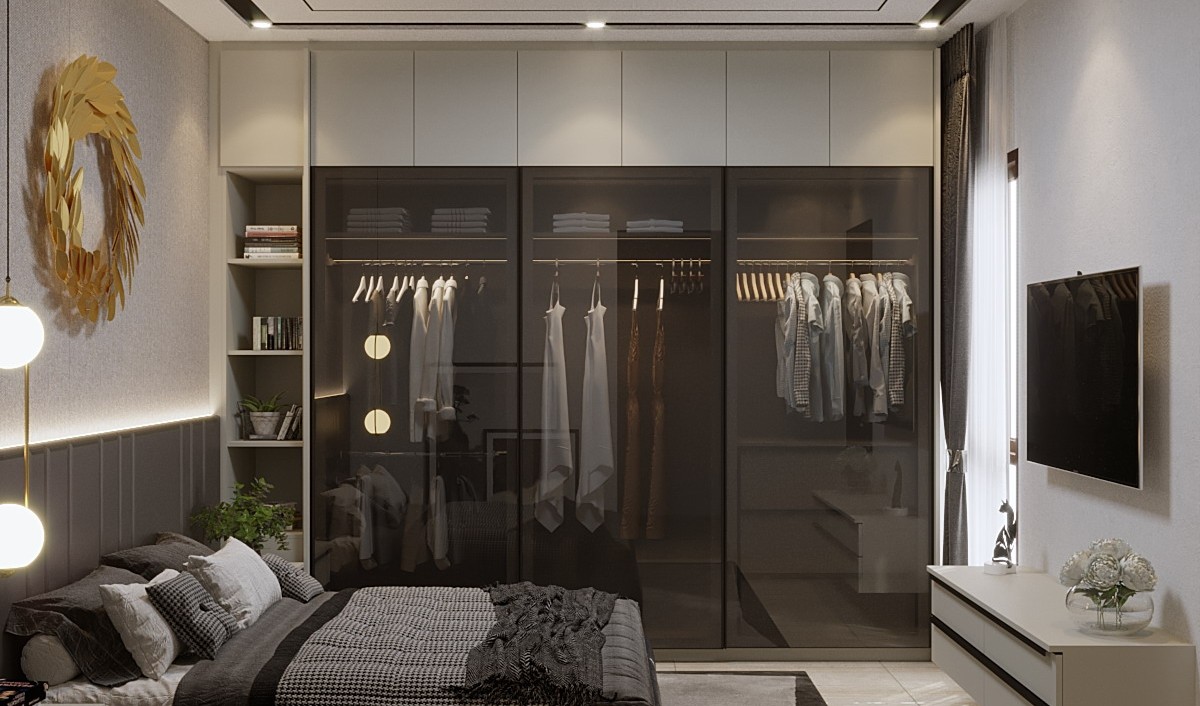
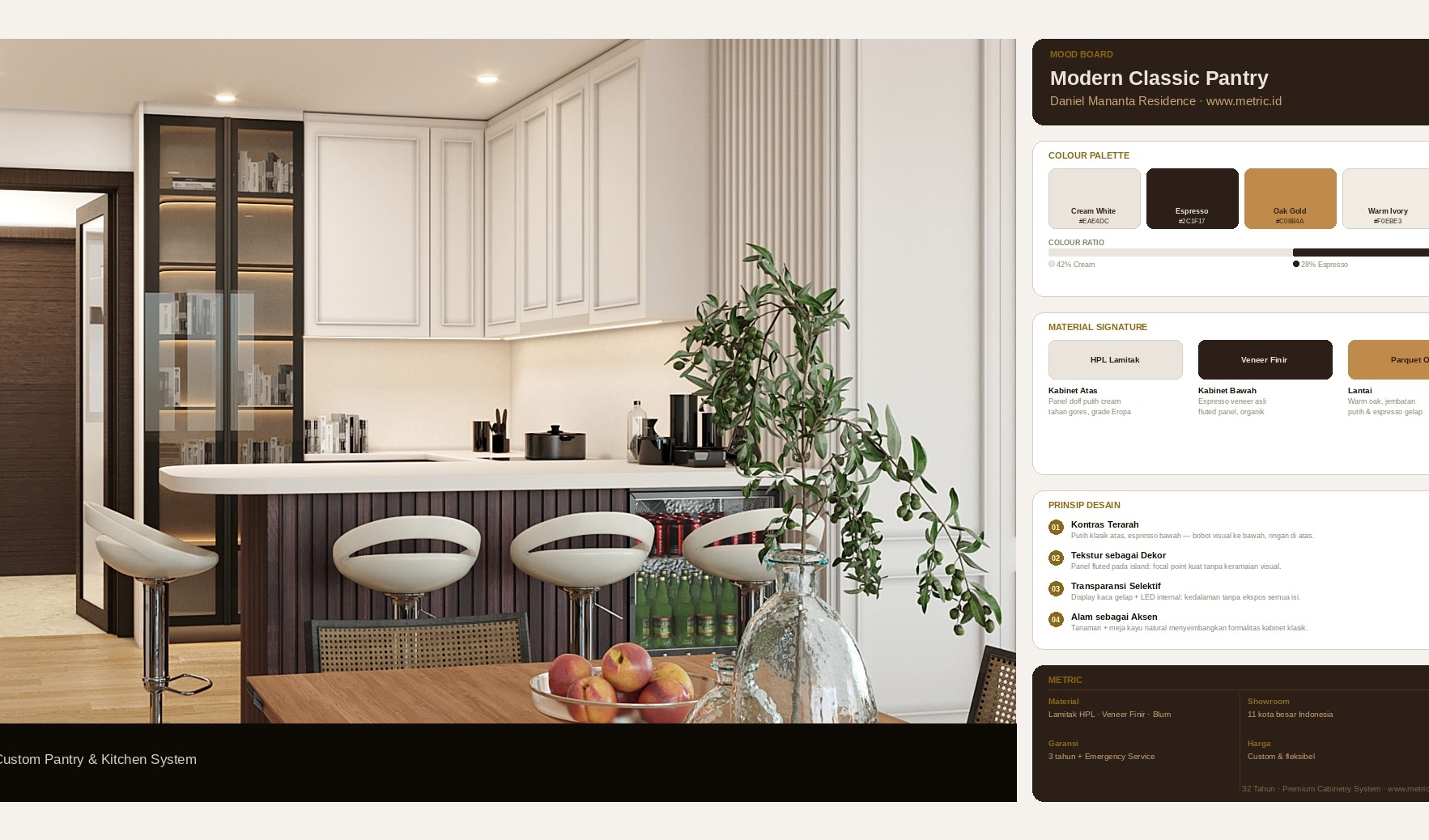
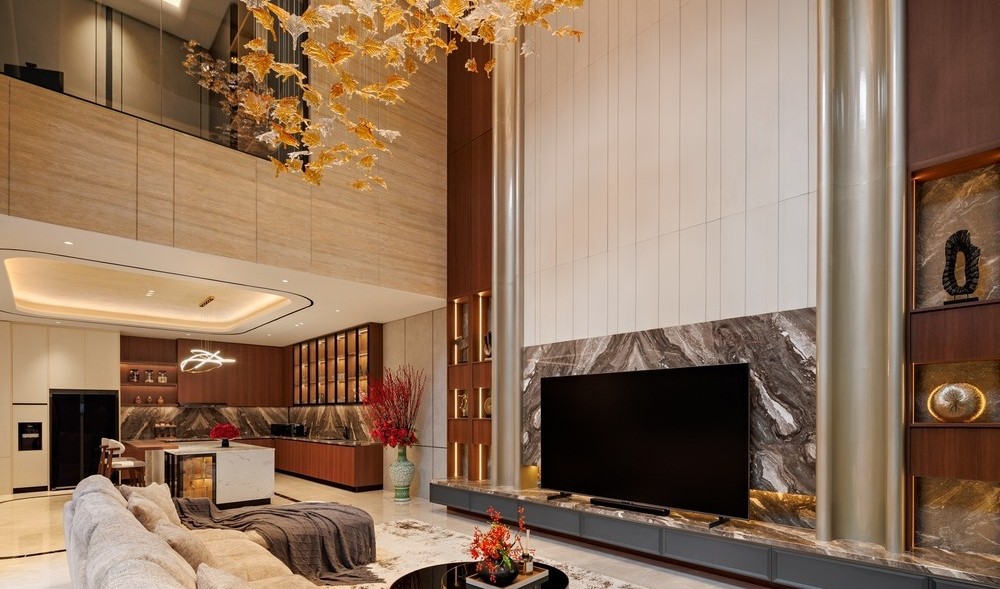
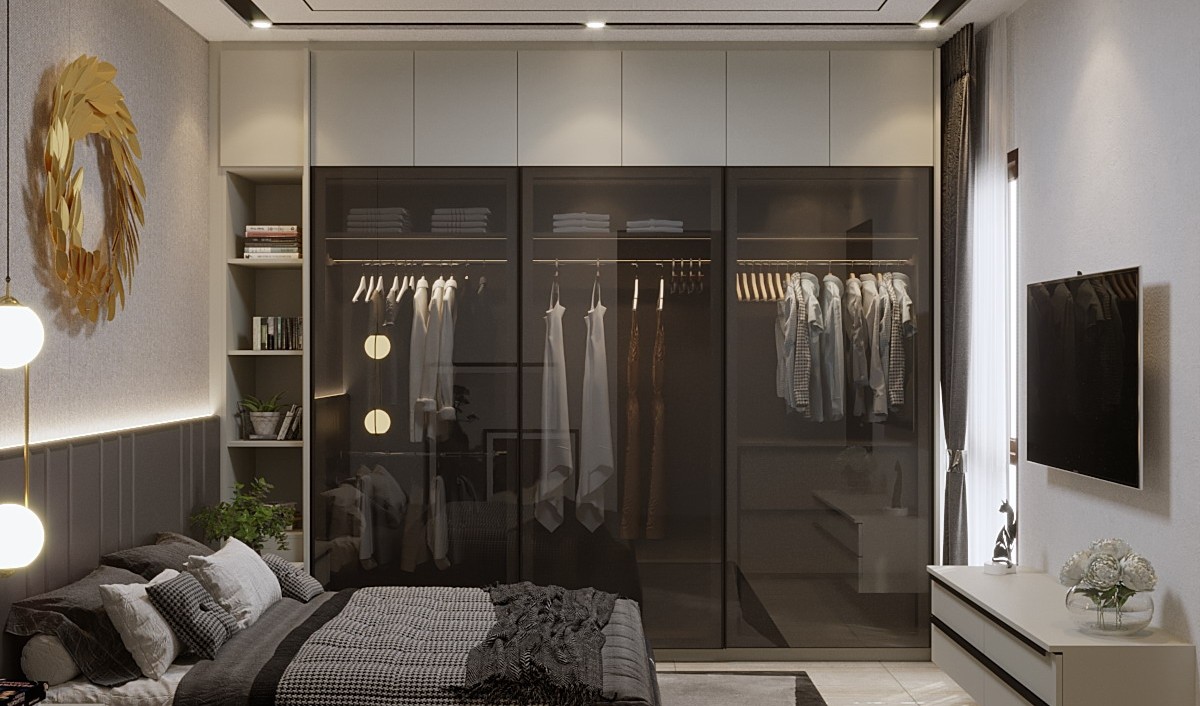
The most effective solution is concealed storage — a hidden storage system that integrates seamlessly with the surrounding wall. A built-in wardrobe from floor to ceiling, a kitchen set whose panels are flush with the wall surface, a TV cabinet that becomes one with its marble backdrop — all designed to visually 'disappear' the furniture and create a clean, uninterrupted wall surface.
When walls appear clean and free from objects projecting into the room, the eye encounters no 'obstacles' as it sweeps from one side of the room to the other. The result: the room feels twice as spacious as its actual dimensions, even though you are storing the same volume of belongings.
This is precisely why a custom interior system is significantly more effective than off-the-shelf furniture for small spaces. Standard-dimension furniture cannot fill every centimetre of wall space with precision — there are always gaps, unused corners, and visual irregularities that cannot be avoided.
📎 Internal Link: https://www.instagram.com/p/DXg1g99gV9m/?img_index=1&igsh=NmFxZWc5c2twbmtk
✦ METRIC: AFFORDABLE LUXURY
A question frequently raised: why is Metric more expensive than standard furniture retailers? Because what you purchase from Metric is not simply a cabinet or kitchen set — you are investing in a custom interior system designed specifically for your home, produced with internationally certified CNC precision machinery, and protected by a 3-year product warranty.
Metric is premium because it uses European-grade materials throughout: Lamitak HPL laminates that resist scratches and wear, Finir natural wood veneer that delivers genuine organic warmth, and Blum precision fittings for every hinge and drawer — materials engineered not merely to look exceptional today, but to remain so for years to come.
Yet Metric's defining philosophy is Affordable Luxury: genuine luxury should not be the exclusive domain of the privileged few. With pricing that is custom and flexible to each client's specific requirements and chosen materials, every Indonesian family can access interior design that is beautiful, functional, and lasting. Not luxury that overextends — but luxury that is wisely planned.
3-year product warranty. Emergency service. 11 showrooms nationwide. Real value for a real investment.
6. Mirrors and Glass: Visually Doubling Your Space
No trick is more immediately and dramatically effective at multiplying the visual size of a room than a large, well-positioned mirror. A single large mirror mounted on the right wall can literally make a room appear twice as long or twice as wide.
The key to mirror placement is to orient it facing a light source — a window, a glass door, or a prominent light fixture. A mirror facing light will reflect and distribute that light throughout the room, while simultaneously creating an impression of depth that pushes the visual boundary of the space further away.
A more refined alternative to plain mirrors is patterned glass or textured glass panels on wardrobe doors. This material delivers a similar spatial effect with a more subtle and premium visual character — an ideal choice for rooms with a modern or Japandi aesthetic.
Additionally, the use of glass as a room partition — for example, between a living room and a study, or between a bathroom and a bedroom — preserves functional separation without blocking lines of sight. The eye can still 'pass through' to the adjacent space, and both rooms appear to merge into a single, larger whole.
7. Warm Neutral Colours: The Palette That Opens Space
Colour is the most powerful psychological signal in interior design. Dark colours tend to absorb light and make walls feel closer, while light colours reflect light and create the impression of a more open and generous space.
For small rooms, the most effective palette is warm neutral tones — cream, off-white, warm grey, and limestone. These colours not only reflect light effectively but also create a warm and calming atmosphere that happens to be the dominant trend in contemporary interior design.
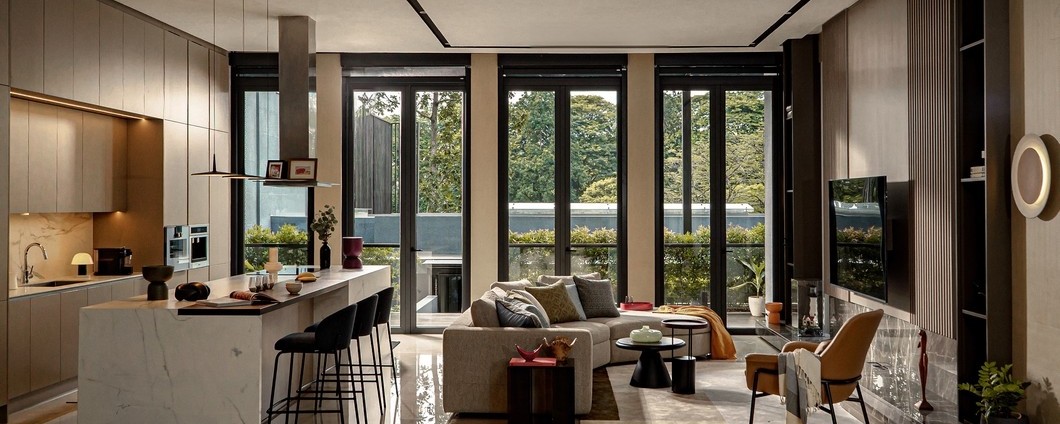
The advanced technique: use the same or very similar colour for walls, ceiling, and built-in furniture. When there is no pronounced colour difference between the wall and the cabinetry, the eye finds no clear 'boundary' and the room feels seamless and larger. This is the same technique employed in the showrooms of global luxury brands — and it can be applied in your own home.
All seven of the above tricks share one foundational principle: a room that feels spacious is the product of intelligent design, not merely generous dimensions. By understanding how human visual perception works and applying the right principles — from flooring selection and curtain placement to wall-integrated storage systems — even the smallest room can be transformed into a living space that feels open, considered, and genuinely refined.
It is important to remember that most of these tricks work most powerfully when applied as an integrated system — not individually in isolation. A kitchen set that integrates seamlessly with the wall is far more effective when paired with wide-format, minimal-grout flooring and a matching wall colour tone. A floor-to-ceiling built-in wardrobe creates its greatest impact when combined with concealed lighting and a lighter-toned ceiling.
This is where the true value of working with an experienced design team becomes clear — a team that understands the entire interior ecosystem of your home, not merely one element in isolation.
"The results of their work were as expected. I would rate them 9.5/10. You get what you pay for. I trust Metric more because it was recommended by my family." — Liza, Central Jakarta
Consult with Metric's expert team on your interior requirements — from kitchen sets and built-in wardrobes to custom TV cabinets — at your nearest showroom, or explore hundreds of design inspirations at www.metric.id. Backed by a 3-year product warranty, emergency service support, and 11 showrooms across Indonesia, your ideal interior is more attainable than you may expect.
© Metric | www.metric.id | @metric_id | 32 Years of Affordable Luxury Interior Design in Indonesia
There is a persistent myth among Indonesian homeowners that a spacious-feeling home is the exclusive privilege of those with large plots of land. In reality, the sense of spaciousness in a room has far less to do with its actual square footage than with how that space is designed and organised.
Professional interior designers have long understood that the perception of space is a science. The human brain processes its environment through visual signals — lines, surfaces, colours, and textures — and each of these signals can be deliberately and intelligently manipulated to create an impression of a room that differs significantly from its actual dimensions.
In this article, Metric shares 7 evidence-based design tricks used by professional designers to make small rooms feel genuinely spacious, open, and comfortable — without major structural renovation or the acquisition of additional land.
1. Choose Wide-Format Flooring with Minimal Grout Lines
The first secret lies beneath your feet. The type and size of your floor covering has a far greater impact on the perceived size of a room than most people realise.
The principle is straightforward: the fewer visual interruptions on the floor surface, the more spacious the room appears. Small tiles — such as 20x20 cm mosaic — create dozens or even hundreds of grout lines that continuously interrupt the eye's field of vision. The brain registers each of these lines as a 'boundary', and unconsciously interprets the room as smaller than its actual dimensions.
Conversely, wide-format flooring materials — large-cut marble at 80x80 cm or 120x120 cm, large-format granite, or long-plank SPC (*Stone Plastic Composite*) — minimise the number of grout lines visible. With fewer lines interrupting the field of vision, the brain reads the floor surface as one continuous, unbroken expanse, and the room immediately registers as more spacious.
Metric's tip: The direction of installation also matters. Laying flooring diagonally (at a 45° angle to the walls) creates the illusion of a longer and wider room, as the diagonal is the longest line within any given rectangular space.
📎 Internal Link: https://metric.id/en/inspiration
2. Paint the Ceiling Lighter Than the Walls
This is the easiest and most frequently overlooked trick: ceiling colour determines the perceived height of a room. When the ceiling is painted the same shade or darker than the walls, it optically 'descends', making the room feel lower and more confined.
The solution is to paint the ceiling one to two shades lighter than the wall colour. If your walls are light grey, paint the ceiling pure white. If the walls are warm cream, the ceiling can be off-white. This subtle tonal difference creates a vertical gradient that psychologically 'pushes' the ceiling upward.
For a more dramatic effect, incorporate cove lighting — LED strips concealed behind a plaster cornice that illuminate the ceiling from the perimeter. The upward wash of light creates a 'floating' effect on the ceiling, making it appear to hover higher than its actual position.
3. Low-Profile Furniture for the Illusion of a Higher Ceiling
This is one of the most counter-intuitive yet highly effective design tricks: to make a ceiling appear higher, lower the furniture.
The logic is straightforward. When you choose a sofa, bed, or TV console with a low profile, the amount of wall visible above the furniture increases. The eye has more 'vertical travel' — from the furniture surface to the ceiling — and the brain interprets this greater vertical distance as a taller room.
The same principle applies to furniture with visible legs (*elevated legs*). Sofas, chairs, or tables that stand on clearly visible legs — rather than resting solidly on the floor — allow the eye to see a longer run of floor surface. The room appears lighter, more open, and taller simultaneously.
Avoid wall-mounted cabinetry that hangs at mid-height. Choose between two clear options: built-in cabinetry from floor to ceiling (which creates a clean, intentional wall surface), or furniture on distinct legs that clearly separates itself from the floor.
📎 Internal Link: https://www.instagram.com/p/DX3FPLXDBqE/?img_index=2&igsh=eWVweDAwYXg1enYz
4. Floor-to-Ceiling Curtains Mounted at Ceiling Height
Curtain installation is an area where the majority of homeowners make a consistent error: mounting the curtain rail directly above the window frame. This decision visually shortens the wall height and makes the room feel lower than it actually is.
The technique used by professional interior designers is to mount the curtain rail directly below the ceiling — not above the window — and allow the curtain fabric to fall in one unbroken vertical line to the floor. In this way, the eye follows a long, continuous vertical line from ceiling to floor, and the room automatically registers as taller and more imposing.
For the best result, select curtains in a lightweight, flowing fabric — sheer linen or voile — in a neutral tone that closely matches the wall colour. Curtains that contrast sharply with the wall colour will visually sever the room, while those that harmonise create the impression of a wall that extends seamlessly without boundary.
5. Built-In Storage Systems That Integrate with the Wall
One of the greatest 'space thieves' in Indonesian homes is not the room's actual size, but the belongings that accumulate without an adequate storage system. Visual clutter is the primary enemy of a room that feels spacious.
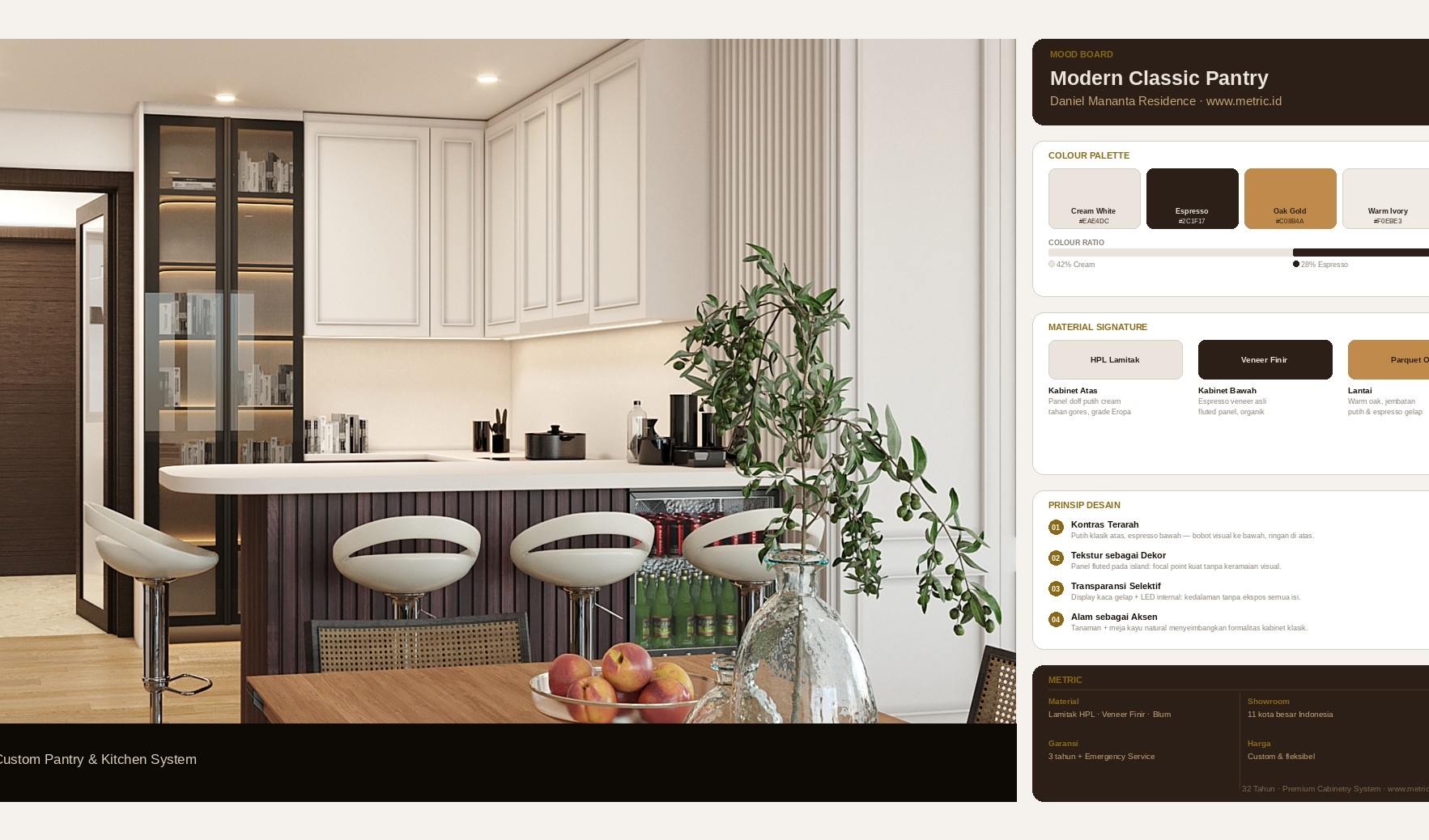
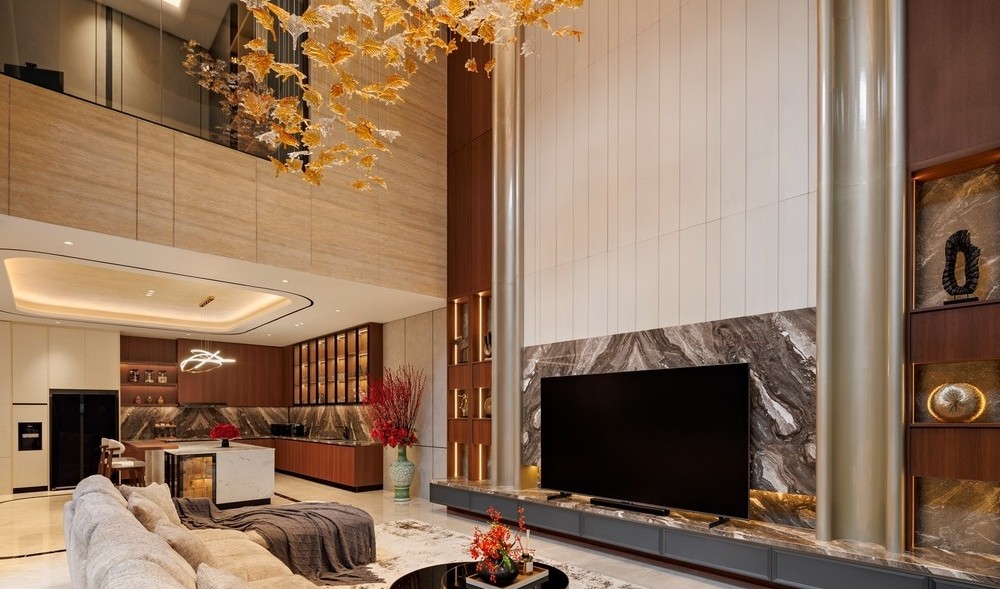
The most effective solution is concealed storage — a hidden storage system that integrates seamlessly with the surrounding wall. A built-in wardrobe from floor to ceiling, a kitchen set whose panels are flush with the wall surface, a TV cabinet that becomes one with its marble backdrop — all designed to visually 'disappear' the furniture and create a clean, uninterrupted wall surface.
When walls appear clean and free from objects projecting into the room, the eye encounters no 'obstacles' as it sweeps from one side of the room to the other. The result: the room feels twice as spacious as its actual dimensions, even though you are storing the same volume of belongings.
This is precisely why a custom interior system is significantly more effective than off-the-shelf furniture for small spaces. Standard-dimension furniture cannot fill every centimetre of wall space with precision — there are always gaps, unused corners, and visual irregularities that cannot be avoided.
📎 Internal Link: https://www.instagram.com/p/DXg1g99gV9m/?img_index=1&igsh=NmFxZWc5c2twbmtk
✦ METRIC: AFFORDABLE LUXURY
A question frequently raised: why is Metric more expensive than standard furniture retailers? Because what you purchase from Metric is not simply a cabinet or kitchen set — you are investing in a custom interior system designed specifically for your home, produced with internationally certified CNC precision machinery, and protected by a 3-year product warranty.
Metric is premium because it uses European-grade materials throughout: Lamitak HPL laminates that resist scratches and wear, Finir natural wood veneer that delivers genuine organic warmth, and Blum precision fittings for every hinge and drawer — materials engineered not merely to look exceptional today, but to remain so for years to come.
Yet Metric's defining philosophy is Affordable Luxury: genuine luxury should not be the exclusive domain of the privileged few. With pricing that is custom and flexible to each client's specific requirements and chosen materials, every Indonesian family can access interior design that is beautiful, functional, and lasting. Not luxury that overextends — but luxury that is wisely planned.
3-year product warranty. Emergency service. 11 showrooms nationwide. Real value for a real investment.
6. Mirrors and Glass: Visually Doubling Your Space
No trick is more immediately and dramatically effective at multiplying the visual size of a room than a large, well-positioned mirror. A single large mirror mounted on the right wall can literally make a room appear twice as long or twice as wide.
The key to mirror placement is to orient it facing a light source — a window, a glass door, or a prominent light fixture. A mirror facing light will reflect and distribute that light throughout the room, while simultaneously creating an impression of depth that pushes the visual boundary of the space further away.
A more refined alternative to plain mirrors is patterned glass or textured glass panels on wardrobe doors. This material delivers a similar spatial effect with a more subtle and premium visual character — an ideal choice for rooms with a modern or Japandi aesthetic.
Additionally, the use of glass as a room partition — for example, between a living room and a study, or between a bathroom and a bedroom — preserves functional separation without blocking lines of sight. The eye can still 'pass through' to the adjacent space, and both rooms appear to merge into a single, larger whole.
7. Warm Neutral Colours: The Palette That Opens Space
Colour is the most powerful psychological signal in interior design. Dark colours tend to absorb light and make walls feel closer, while light colours reflect light and create the impression of a more open and generous space.
For small rooms, the most effective palette is warm neutral tones — cream, off-white, warm grey, and limestone. These colours not only reflect light effectively but also create a warm and calming atmosphere that happens to be the dominant trend in contemporary interior design.
The advanced technique: use the same or very similar colour for walls, ceiling, and built-in furniture. When there is no pronounced colour difference between the wall and the cabinetry, the eye finds no clear 'boundary' and the room feels seamless and larger. This is the same technique employed in the showrooms of global luxury brands — and it can be applied in your own home.
All seven of the above tricks share one foundational principle: a room that feels spacious is the product of intelligent design, not merely generous dimensions. By understanding how human visual perception works and applying the right principles — from flooring selection and curtain placement to wall-integrated storage systems — even the smallest room can be transformed into a living space that feels open, considered, and genuinely refined.
It is important to remember that most of these tricks work most powerfully when applied as an integrated system — not individually in isolation. A kitchen set that integrates seamlessly with the wall is far more effective when paired with wide-format, minimal-grout flooring and a matching wall colour tone. A floor-to-ceiling built-in wardrobe creates its greatest impact when combined with concealed lighting and a lighter-toned ceiling.
This is where the true value of working with an experienced design team becomes clear — a team that understands the entire interior ecosystem of your home, not merely one element in isolation.
"The results of their work were as expected. I would rate them 9.5/10. You get what you pay for. I trust Metric more because it was recommended by my family." — Liza, Central Jakarta
Consult with Metric's expert team on your interior requirements — from kitchen sets and built-in wardrobes to custom TV cabinets — at your nearest showroom, or explore hundreds of design inspirations at www.metric.id. Backed by a 3-year product warranty, emergency service support, and 11 showrooms across Indonesia, your ideal interior is more attainable than you may expect.
© Metric | www.metric.id | @metric_id | 32 Years of Affordable Luxury Interior Design in Indonesia